ACLU OF ALABAMA CALLS ON LEADERS TO MAKE PRISONS TOP PRIORITY IN COVID-19 RESPONSE

Montgomery, Ala. — Close to 22,000 Alabamians incarcerated by the Alabama Department of Corrections (ADOC) face a much higher risk of contracting coronavirus than the general public, but there’s been no mention of plans to ensure their safety and well-being. Last week Governor Kay Ivey announced the formation of a Coronavirus Task Force, and the ACLU of Alabama urges the group to prioritize plans for Alabama prisons, which were already experiencing a sustained overcrowding and understaffing crisis before the pandemic.

Statement from Randall Marshall, Executive Director, ACLU of Alabama:

“Incarcerated people cannot follow the CDC recommendation of social distancing, and because Alabama prisons are already operating at 170 percent of their designed capacity, these men and women are at an increased risk of exposure and contamination in the prison population. Furthermore, with over 20 percent of people in ADOC custody over the age of 50, there are thousands who are at higher risk of serious health complications or death if they are infected.

It is imperative that the Governor and ADOC release their plans to prevent the spread of COVID-19 inside the prisons, to quarantine and care for any prisoner who shows symptoms, and to ensure all supplies and food remain stocked during this crisis. They must also address how they plan to provide continued staffing in the event of staff shortages due to illness or caring for an ill family member. ADOC staffing is currently at 40 percent.

These and other questions must be answered now. Alabama leaders have historically disregarded the health and safety of the men and women incarcerated in state prisons. The ACLU of Alabama urges state leaders to not follow that old pattern and make prisons a top priority in Alabama’s COVID-19 response.”

Please sign the petition here calling for President Trump and all state governors to heed the recommendations of public health professionals: Release communities who are most vulnerable to COVID-19 – particularly the elderly and sick – and reduce overcrowding in our criminal legal system.

 

People Serving Life Exceeds Entire Prison Population of 1970

Campaign to end life imprisonment

As states come to terms with the consequences of 40 years of prison expansion, sentencing reform efforts across the country have focused on reducing stays in prison or jail for those convicted of nonviolent drug and property crimes. At the same time, policymakers have largely neglected to address the staggering number of people serving life sentences, comprising one of seven people in prisons nationwide.

International comparisons document the extreme nature of these developments. The United States now holds an estimated 40% of the world population serving life imprisonment and 83% of those serving life without the possibility of parole. The expansion of life imprisonment has been a key com- ponent of the development of mass incarceration.

In this report, we present a closer look at the rise in life sentences amidst the overall incarceration expansion.

To place the growth of life imprisonment in perspective, the national lifer population of 206,000 now exceeds the size of the entire prison population in 1970, just prior to the prison population explosion of the following four decades. In 24 states, there are now more people serving life sentences than were in the entire prison population in 1970¹ and in an additional nine states, the life imprisonment total is within 100 people of the 1970 prison population.

Figure 1. Comparison of Life Sentenced-Population in 2016 to Prison Population in 1970

Ex: Texas’ life-sentenced population is 1.2X the size of its overall prison population in 1970

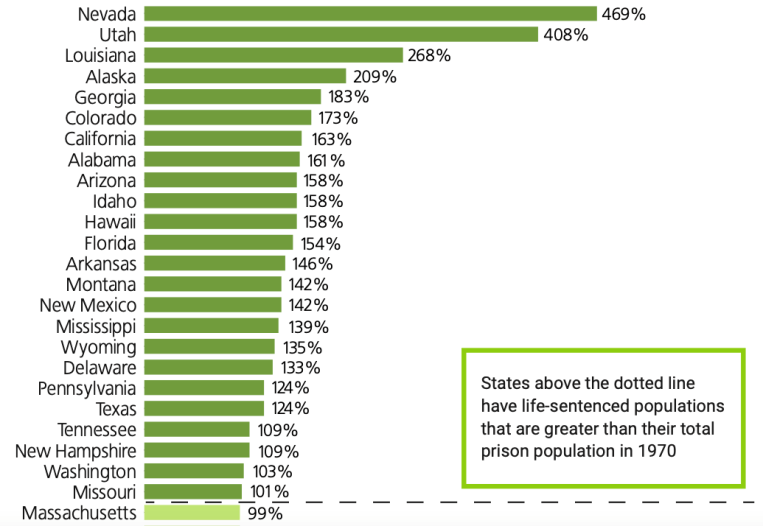
Figure 2. Percent Difference Between Life-Sentenced Population in 2016 and Total Prison Population in 1970

States above the dotted line have life-sentenced populations that are greater than their total prison population in 1970

States above the dotted line have life-sentenced populations that are greater than their total prison population in 1970

A misinterpretation of the connections between the seriousness of an incarcerated person’s crime and their recidivism risk after release often justifies policymakers’ endorsement of life imprisonment. Most people serving life, including for murder, will not forever present a risk to public safety. Even so-called “chronic-offenders,” people who have committed repeated crimes, gradually desist from criminal conduct so that their public safety risk is substantially reduced by their late 30s or 40s. Therefore, from a public safety perspective, life imprisonment is an unwise investment.

In 24 states, there are now more people serving life sentences than were in the entire prison population in 1970

States with the largest effects are in the South and West of the country, though the growth in life sentences in all states has been dramatic over these decades. Figure 2 provides a view of the states ranked by the percent difference between the current number of life-sentenced prisoners and the total prison population in 1970.

Nevada and Utah are at the top of the table because these states’ current life-sentenced populations are more than four times each states’s entire prison

In 24 states, there are now more people serving life sentences than were in the entire prison population in 1970 population in 1970. The next two most dramatic shifts are in Louisiana and Alaska² where their life-sentenced populations are more than double their overall prison populations in 1970.

States farther down the table, such as Ohio, show that there are 70% as many life-sentenced prisoners today as the entire prison population in 1970. And in Maine at the bottom, the growth in life-sentenced prisoners is still notable: the number of lifers today reflects 26% of the total prison population from 1970.

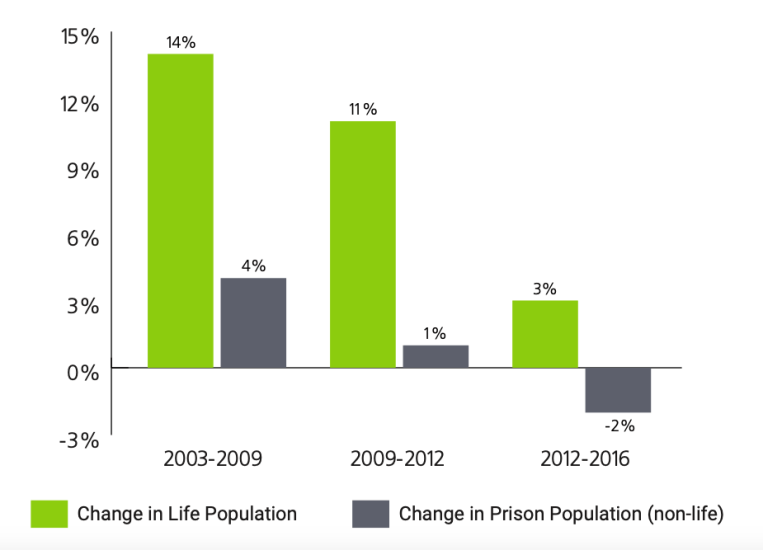
Figure 3. Population Change in Prison Population and Life-Sentenced Population, 2003-2016

Population Change in Prison Population and Life-Sentenced Population, 2003-2016

The Sentencing Project has collected information from state departments of corrections regarding the number of people serving life sentences at four distinct points in time: 2003, 2009, 2012, and 2016. This allows us to observe trends in life imprisonment. We find that while prison totals have declined by 0.5% between 2003 and 2016, there has been a 30% increase in life sentences.

While prison totals have declined by 0.5% between 2003 and 2016, there has been a 30% increase in life sentences

A further troubling aspect within this rise is that the most severe of the three categories of life sentences— life without the possibility of parole, or LWOP—has risen the fastest. As illustrated in Figure 4, we find a 59% rise in these sentences between 2003 and 2016 compared with an 18% increase in life with the possibility of parole.

Reasons for the continued growth in life sentences despite reversals in crime and incarceration more generally point to various “tough on crime” policies that hold people in prison longer on their life sentences.

These include habitual offender laws, mandatory minimums, elimination of parole, and the transfer of juveniles to the adult system. These policies were advanced by legislators in the 1990s, and contributed to the sharp increase in life sentences, but have since come under greater scrutiny.

As states rethink their regimes on punishment so that public safety is paired with fairness, it is clearly important to adopt reforms for those individuals convicted of low-level and nonviolent crimes. But it would also be wise from a moral and fiscal standpoint, as well as the standpoint of public safety, to give a second look to those serving life sentences as well.

Figure 4. Life without Parole Growing More Quickly Than Life with Parole, 2003-2016

Life without Parole Growing More Quickly Than Life with Parole, 2003-2016

¹ Prison population data was not available for Alaska, Arkansas, and Rhode Island in 1970, so for these states we use prison population data for 1971.

² Life with or without parole is not statutorily defined in Alaska’s criminal code, but the state allows sentences we identify as “virtual life” terms of 50 years or more.

Screenshot 2020-03-05 at 22.06.12

Screenshot 2020-03-05 at 22.08.04

Screenshot 2020-03-05 at 22.09.21

Originally published here