BIRMINGHAM, Ala. (AP) — Alabama legislators have put a temporary hold on a $10 million contract between the state Department of Corrections and a company that could analyze prison needs and design new facilities.
Al.com reports the Legislature’s contract committee paused the plan Thursday amid questions about its reliability, considering construction plans for new prisons failed in 2016 and 2017. Corrections Commissioner Jeff Dunn says planning for new prisons is a better use of tax dollars than putting more money into older prisons that need to be replaced.
He says it would cost about $1 billion to build three new regional prisons, including one that can accommodate inmates with high-need mental health issues.
One committee member said the Legislature is unlikely to pass a $1 billion prison plan.
article published 10/20/2017 & originally posted here
An Alabama Prison
The Alabama Department of Corrections (ADOC) must conduct a meaningful analysis of the staffing it needs to address an unconstitutionally inadequate level of care for prisoners who have mental illnesses, according to a brief filed in federal court yesterday by the SPLC.
ADOC will likely need more than double its current level of correctional staffing and nearly triple its mental health staffing, according to the brief. Additionally, the court should appoint security and mental health monitors to ensure that ADOC is carrying out the court-approved remedies, the brief states.
The filing is in response to a plan that ADOC proposed to the federal court last week, claiming that it would increase spending for mental health care workers – and would double staffing in those positions – but only if the state legislature provides enough funding next year.
“Compliance with the U.S. Constitution is not optional, and the state can delay no longer. Mental health staffing is woefully inadequate in ADOC prisons, and the flagrant constitutional violations that result must be addressed immediately in order to protect prisoners with mental illnesses from an ongoing risk of serious harm,” said Maria Morris, senior supervising attorney with the SPLC. “ADOC’s plan to remedy these glaring staffing deficiencies is vague, unsubstantiated and incomplete. It must address these issues now.”
The filing is the latest development in the SPLC’s ongoing litigation against ADOC for failing to provide adequate medical and mental health care for people in its custody. U.S. District Court Judge Myron Thompson issued a sweeping, 302-page ruling in June declaring the mental health care system in Alabama prisons “horrendously inadequate.”
The court specifically found that “persistent and severe shortages of mental-health staff and correctional staff” are among the overarching issues that contribute to the inadequacy of mental health care in ADOC prisons.
The court also found that ADOC’s mental health caseload is substantially lower than the national average, and that this failure to identify prisoners with mental health needs is the result of a number of factors, including “insufficient mental-health staffing.”
Recruiting and retaining adequate staff will take time and funding, but ADOC already has the authority and funding to hire some correctional staff right now. For example, ADOC does not need legislative approval to fill its existing, authorized staffing levels.
“Throughout this case, the court has repeatedly made it clear that lack of funds is not an excuse for ADOC’s failure to provide constitutionally mandated care to prisoners with mental illnesses,” Morris said. “ADOC officials have known for years that they need more staff, but they have delayed addressing the problem. Now, they want to delay even further, leading to more pain, suffering and possibly even death.”
Morris said: “The state has an immediate duty to hire enough qualified staff to address the crisis in care for the mentally ill. Over the long term, however, the only solution to this and other problems in the Alabama prison system is to decrease the prison population by getting people the help they need to stay out of prison in the first place. The state should ensure that people with mental illness get treatment, instead of just locking them up and throwing away the key.”
Not one of Alabama’s 15 state prisons has a functional fire alarm system, according to Department of Corrections Commissioner Jeff Dunn, who spoke to lawmakers earlier this week about overcrowding inside state correctional facilities.
“It’s pervasive in our system … that we have deficiencies in our fire alarm systems,” said Dunn. “So what we do, we have corrections officers posted throughout and if there’s an issue, we do it through a verbal system. Obviously, we have procedures if we have a fire to evacuate either portions or all of the facility but the aural fire alarms, we have deficiencies around the state.”
The revelation comes during a trying time for the state’s prisons. The system is at approximately 180 percent of capacity while the number of correctional officers required is dangerously low, according to previous AL.com reporting.
In 2016, Governor Robert Bentley put forth what’s known as the Alabama Prison Transformation Initiative (APTI), a plan to build four mega prisons at a cost of $800 million. While the initiative passed through both the House and the Senate, it did not gain final approval. In the coming session this year it’s expected that Bentley will raise the issue again with some amendments to help it pass.
Dunn conceded that other problems did exist in terms of infrastructure and health and safety. “I think the salient point is that (failing fire alarms are) just one of a dozen things that we face,” Dunn said. “While I don’t disagree about the fire system, you’ve got problems with electrical, you’ve got problems with plumbing, you’ve got problems all over that need to be addressed.”
Alabama Department of Corrections likes to put out numbers concerning the amount they spend on inmates healthcare, but they are lies. We have to fill out a sick call for each thing that is wrong with us, and pay $4.00 each time. Any over the counter medicine given to us costs $4.00 for each medicine.
Alabama Department of Corrections Healthcare is a Joke
For example, if we sign up for a cold, we are charged $4.00 for the visit, $4.00 for the Ibuprofen, $4.00 for the Sinus pills, and $4.00 for the decongestant. They rarely give out antibiotics. We have to sign up at least 3x before we can see the nurse practitioner or Doctor. When we have an accessed tooth, they put us on the Dental waiting list, sometimes it takes 2 months before you see the Dentist, and then you have to be given antibiotics to get rid of the infection, before the tooth can be pulled.
We’ve had girls with their cheeks swollen 3x the normal size because of an accessed tooth and yet health care will not let them see the Doctor to get started on an antibiotic, whilst waiting to see the Dentist.
Those on chronic care for high blood pressure, have to pay $4.00 if we feel that our blood pressure is up and ask to have our blood pressure checked. If you complain about the healthcare at Montgomery Women’s Facility too much, they will send you back to Tutwiler, where no one wants to go. Its their way of punishing us for speaking out against their mistreatment. We call healthcare, deathcare and most of us try to avoid their type of care.
Correctional Medical Services, which later became Corizon, held the contract from 2007 to 2012. ADOC awarded Corizon the healthcare contract in 2012, through to Sept. 30, 2017, under extension, it was the only company to submit a bid. The $181 million extension will bring the total cost of the contract to $405 million. State funds pay 100 percent of the cost. So why the hell are inmates forced to pay for each appointment despite having to wait in some cases months to see a healthcare professional and then pay extortionate prices for over the counter medicine which cost pennies in the free world and where the hell are they supposed to get the money from in the first place?
The Southern Poverty Law Center and Alabama Disabilities Advocacy Program have sued Alabama Department of Corrections, over the failure to provide adequate medical care, mental health care and accommodations for the disabled violates the constitution and federal law. Despite ADOC claiming their “healthcare” is adequate, it has agreed to improve conditions for inmates with disabilities, the lawsuit is ongoing and in fact, The SPLC, the Alabama Disabilities Advocacy Program and the law firm of Baker Donelson have asked a federal judge to certify its lawsuit against the Alabama Department of Corrections (ADOC) as a class action, which would allow rulings in the case over the inadequate medical and mental health care of 43 prisoners named in the lawsuit to apply to the 25,000 people held in a prison system that has had one of the highest mortality rates in the country.
Article Originally published here on January 09, 2017 at 3:35 PM, updated January 09, 2017 at 3:39 PM
Inmates sitting on their bunks in a dorm in Julia Tutwiler Prison in Wetumpka. (Julie Bennett/jbennett@al.com)
By Dr. Larry F. Wood, retired clinical and correctional psychologist
I spoke out on the prison reform issue two years ago after working in Tutwiler women’s prison as a prison psychologist. Even after 25 years of professional experience in prisons, I was unprepared for the immensity of the problems. In particular, mental health and medical care were severely inadequate. The administration of the prison was unprofessional and abusive. Two years ago, I described the prison environment as a culture of abuse.
In the past two years, a federal investigation has continued and a trial is under way. The State of Alabama continues to deny that the conditions are unconstitutional. No substantial improvements or program changes have been announced. Governor Bentley has focused on borrowing money to build more prisons.
I have been disappointed that little seems to have happened over the past two years. State Senator Cam Ward has spoken eloquently on the subject, but there seems to be no political will to address the problem directly.
One core of the problem is the simple overuse of imprisonment to deal with social problems other than aggressive criminality. The most extreme example is mental illness. State hospitals were closed because of abusive conditions and now, most of the seriously mentally ill in our state are in prisons. Many other inmates are intellectually inadequate, socially unskilled, or drug addicted. Many were traumatized by a lifetime of physical, emotional or sexual abuse.
Prisons were initially used to control and punish the overtly dangerous. Their role has been expanded over many years to include the chronically disruptive in society. Such people are arrested numerous times and are backed up in county jails, waiting for beds to house them in prison. Prison, as a punisher, is not appropriate or effective for many such inmates.
Simply stated, Alabama’s prisons are overcrowded because too many people are being held in expensive, high security lockups. If our prisons were reduced to recommended population levels, they could be operated safely and professionally. Minimum security facilities with focused treatment and programs would be far less expensive than prisons for most inmates.
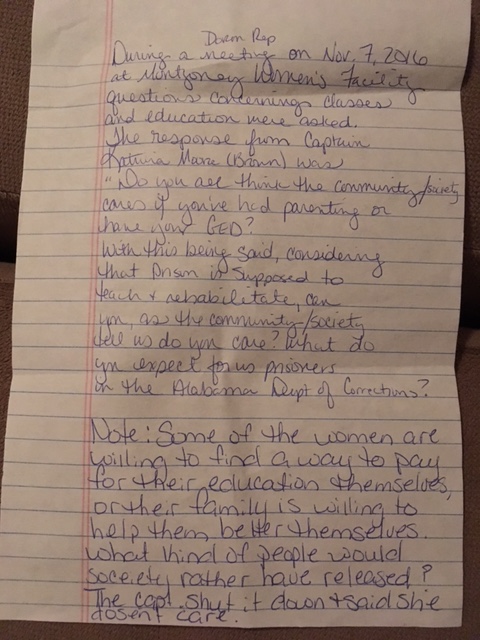
During a meeting on November 7th 2016 at Montgomery Women’s Facility, questions concerning classes and education were asked. The response from Captain Katrina Moore (Brown) was “No you all think the community/society cares if you’ve had parenting or have your GED?”
With this being said, considering that prison is supposed to teach & rehabilitate, can you, as the community/society tell us, do you care? What do you expect for us prisoners in the Alabama Dept of Corrections?
Note: Some of the women are willing to find a way to pay for their education themselves, or their family is willing to help better themselves. What kind of people would society rathe have released? The Capt. Shut it down & said she doesn’t care.
Transcribed from a letter by inmate T, identity withheld for fear of retaliation
Montgomery Women’s Facility has been without a full time Warden since Mr Edward Ellington left to take over at Draper Correctional Facility in March 2016. Wardenship passed temporarily to Warden Terrance during which time conditions within the facility took a drastic turn for the worse, Ms Terrance left in August and the Captain has been acting as warden since.
Alabama Department of Corrections staffing woes and their impact, are still negatively felt throughout all aspects of ADOC, it has been reported that at other facilities, Correctional Officers have gone on strike citing the dangerous conditions that are festering as the upper echelons of Alabama Department of Corrections struggle to get a grip on a system that is failing from the top all the way down. Its not just an issue of safety and security, the absence of a classification officer as at Montgomery Women’s Facility increases stress, tension and creates an additional bottleneck in an already dangerously over crowded prison system, people that have served their sentences, especially those that are considered long-timers should be high on the list of priorities as they approach their parole and end of sentence dates.
Classification Officers are supposed to interview and assess amongst other things the custodial level biannually, effectively allowing those that have a low enough custody level, to be able to work and be in preparation for their release. Having no classification officer is a serious issue and it keeps women held on higher custodial levels than which they are entitled too, in an already over populated, neglectful and abusive prison system, common sense you would have thought, would be a priority, facilitating the lowering of custodial levels to those eligible, effectively freeing up bed space and hastening the transition back into society, not to mention raising moral, giving hope to those that have often served many years from dubious convictions.
Bear in mind too, that Alabama cases are difficult for many reasons, for example Post-conviction records are exceptionally hard to obtain in Alabama, and there is no specific post-conviction DNA testing statute except in capital cases. New evidence often must be brought before a court within six months of discovery, which can be extremely difficult and at times, impossible. Alacourt.com controls public court records in Alabama and charges exorbitant access fees, making the records virtually inaccessible to those incarcerated or their families which are generally on low incomes, Alabama needs to rethink its policy on locking people up and throwing away the keys, giving fair hearings, trials and sentences would be a great start.
By J. Celso Castro Alves, Truthout | News Analysis
In theory, a public defender’s mission includes dedicated advocacy for clients against whom the power of the carceral state is mobilised. In theory, a public defender’s mission includes dedicated advocacy for clients against whom the power of the carceral state is mobilized. However, in practice, defenders sometimes end up working with the forces of power — and against the best interests of their clients. (Photo: Pixabay)
On January 5, 2015, Randall H. McCants Jr. was not alone when Judge James H. Roberts Jr. of the Sixth Judicial Circuit of the State of Alabama opened his courtroom for a plea hearing. “Mr. McCants is present in court with his attorneys, Jim Gentry and Mike Cartee,” he stated. Besides the judge’s reference to McCants’ court-appointed attorneys by their nicknames, nothing appeared out of the ordinary. Roberts cited McCants’ constitutional rights before highlighting his defense attorneys’ central task: “Your attorneys are bound to do everything they can honorably and reasonably do to see that you obtain a fair and impartial trial.” McCants answered the judge’s questions with “yes, sir” and “no, sir.” Even to the charge of capital murder and the question of whether he understood that “the range of punishment is life without parole or death,” McCants responded, “yes, sir.”
According to the nine-page hearing transcript, Roberts knew that McCants had pled not-guilty during his post-arrest arraignment in January 2011. In fact, Roberts acknowledged that McCants’ attorneys had only recently “proposed a plea agreement” for the “lesser offence of murder.” Yet, at no point during the hearing did Roberts wonder about what prompted McCants’ sudden about-face. Did four mysterious years in pretrial detention impact McCants’ decision? Could McCants’ attorneys have coerced him to plead guilty by invoking fear that a greater punishment awaited him at trial? Whether McCants was mentally competent to grasp legal proceedings or understand that he was assuming full responsibility for the accidental death of a Tuscaloosa resident apparently did not cross Roberts’ mind either.
Rather, Judge Roberts proceeded with the plea colloquy by asking prosecutor Jonathan S. Cross to provide “some facts” for the first-degree murder plea. Compliant, Cross stood and delivered some skimpy facts in the most casual and sloppy fashion possible:
Air Conditioners are desperately needed throughout Alabama’s prison system
Edwards and Medlock are trial lawyers with Edwards Law in Austin.
Texas, like other states, does not air condition its prisons—and by doing so, it kills people.
In 2011, the State of Texas convicted Larry McCollum of forgery, for passing a bad check. He was supposed to serve a short prison sentence of two years, then go home to his family. Instead, the conditions inside Texas prisons gave him a death sentence. He died of heat stroke—indoors.
Over 120,000 beds in the Texas Department of Criminal Justice system do not have air conditioning, including the Hutchins State Jail near Dallas, where Mr. McCollum was imprisoned. As a result, the indoor heat index—the combination of temperature and humidity—frequently exceeds 100 degrees on hot summer days. Shortly before Mr. McCollum died, the Hutchins’ warden received multiple emails from the risk manager, who took a thermometer around to the dorms, stating the temperature inside the inmate dormitories reached 102 degrees by early afternoon, and that the heat index inside was likely 123. While Mr. McCollum baked inside his dormitory, his body temperature rose to 109.4. Eventually, his body began to seize, and he was hospitalized. When his wife and adult children were summoned, they learned his body temperature had permanently damaged his brain, and he would not survive.
According to the National Weather Service, in an average year, heat kills more people than floods, lightning, tornadoes and hurricanes combined. In all, during the past 18 years, over 20 men have died with the cause of death of heat stroke inside prison buildings constructed and maintained by the State of Texas. Though the count is likely much higher: When temperatures go over 90 degrees, the medical risk of heat stroke increases markedly, and it can lead to other causes of death, especially for people with certain common medical conditions like diabetes, high blood pressure, or asthma, or who take certain medications, including most mental health prescriptions.





 Montgomery Women's Facility
You must be logged in to post a comment.