article originally posted here by By Neil Schoenherr
More than half of the costs are borne by families, children and community members who have committed no crime
The cost of incarceration in the United States exceeds $1 trillion, or six percent of gross domestic product, and dwarfs the amount spent on corrections alone, finds a new study from Washington University in St. Louis.
“The $80 billion spent annually on corrections is frequently cited as the cost of incarceration, but this figure considerably underestimates the true cost by ignoring important social costs,” said Carrie Pettus-Davis, assistant professor at the Brown School and an expert on incarceration.
A new study, “The Economic Burden of Incarceration in the U.S.,” led by doctoral student Michael McLaughlin, with assistance from Pettus-Davis, draws on a burgeoning area of scholarship to assign monetary values to include costs to incarcerated persons, families, children and communities, which yield an aggregate burden of $1.2 trillion dollars.
Carrie Pettus-Davis
“We find that for every dollar in corrections costs, incarceration generates an additional $10 in social costs,” said Pettus-Davis, director of the Concordance Institute for Advancing Social Justice and co-director of the Smart Decarceration Initiative.
“More than half of the costs are borne by families, children and community members who have committed no crime,” she said.
The scale of incarceration in the U.S. over the past 40 years is unprecedented, Pettus-Davis said. The prison population grew seven-fold as this country became the world leader in incarceration.
“Researchers have devoted considerable effort to estimating the cost of crime, but no study has yet estimated the aggregate burden of incarceration,” Pettus-Davis said.
“Recent reports highlighting the costs to incarcerated persons, families, and communities have made it possible to estimate the true cost of incarceration,” she said. “This is important because it suggests that the true cost has been grossly underestimated, perhaps resulting in a level of incarceration beyond that which is socially optimal.”
By Aleks Kajstura October 19, 2017 and originally published here
With growing public attention to the problem of mass incarceration, people want to know about women’s experience with incarceration. How many women are held in prisons, jails, and other correctional facilities in the United States? And why are they there? While these are important questions, finding those answers requires not only disentangling the country’s decentralized and overlapping criminal justice systems, but also unearthing the frustratingly hard to find and often altogether missing data on gender.
This report provides a first-of-its-kind detailed view of the 219,000 women incarcerated in the United States, and how they fit into the even larger picture of correctional control. Since 2014, the Prison Policy Initiative has quantified the number of people incarcerated in the United States, and calculated the breakdown of people held by each correctional system by offense in an annual Whole Pie: Mass Incarceration report. This report, done in collaboration with the ACLU’s Campaign for Smart Justice, finally provides similar data on women incarcerated in the Unites States. We break the data down to show the various correctional systems that control women, and to examine why women in the various systems of confinement are locked up:
Graphic showing how many women are locked up in the United States
In stark contrast to the total incarcerated population, where the state prison systems hold twice as many people as are held in jails, incarcerated women are nearly evenly split between state prisons and local jails.
The explanation for exactly what happened, when, and why does not yet exist because the data on women has long been obscured by the larger picture of men’s incarceration. The disaggregated numbers presented here are an important first step to ensuring that women are not left behind in the effort to end mass incarceration.
Women are disproportionately stuck in jails
A staggering number of women who are incarcerated are not even convicted: more than a quarter of women who are behind bars have not yet had a trial. Moreover, 60% of women in jail have not been convicted of a crime and are awaiting trial.
Avoiding pre-trial incarceration is uniquely challenging for women. The number of unconvicted women stuck in jail is surely not because courts are considering women, who are generally the primary caregivers of children, to be a flight risk. The far more likely answer is that incarcerated women, who have lower incomes than incarcerated men, have an even harder time affording cash bail. A previous study found that women who could not make bail had an annual median income of just $11,071. And among those women, Black women had a median annual income of only $9,083 (just 20% that of a white non-incarcerated man). When the typical $10,000 bail amounts to a full year’s income, it’s no wonder that women are stuck in jail awaiting trial.
Even once convicted, the system funnels women into jails: About a quarter of convicted incarcerated women are held in jails, compared to about 10% of all people incarcerated with a conviction.
So what does it mean that large numbers of women are held in jail – for them, and for their families? While stays in jail are generally shorter than in stays in prison, jails make it harder to stay in touch with family than prisons do. Phone calls are more expensive, up to $1.50 per minute, and other forms of communication are more restricted – some jails don’t even allow real letters, limiting mail to postcards. This is especially troubling given that 80% of women in jails are mothers, and most of them are primary caretakers of their children. Thus children are particularly susceptible to the domino effect of burdens placed on incarcerated women.
Women in jails are also more likely to suffer from mental health problems and experience serious psychological distress than either women in prisons or men in either correctional setting.
Ending mass incarceration requires looking at all offenses
The numbers revealed by this report enable a national conversation about the policies that impact incarcerated women held in various facilities, and also serve as the foundation for discussions to change the policies that lead to incarcerating women in the first place.
All too often, the conversation about criminal justice reform starts and stops with the question of non-violent drug and property offenses. While drug and property offenses make up more than half of the offenses for which women are incarcerated, the chart reveals that all offenses, including violent offenses that account for roughly a quarter of all incarcerated women, must be considered in the effort to reduce the number of incarcerated women in this country. This new data on women underlines the need for reform discussions to focus not just on the easier choices but on choices that can lead to impactful policy changes.
The tentacles of mass incarceration have a long reach
Even the “Whole Pie” of incarceration above represents just one small portion (16%) of the women under correctional supervision. Again, this is in stark contrast to the general incarcerated population (mostly men), where a full third of those under correctional control are in prisons and jails.
Graphic showing the correctional control of women
The picture of women’s incarceration is far from complete, and many questions remain about mass incarceration’s unique impact on women. Based on our analysis in this report we know that a quarter of incarcerated women are unconvicted. But is that number growing? And how does that undue incarceration load intersect with women’s disproportionate caregiving burdens to impact families? Beyond these big picture questions there are a plethora of detailed data points that are not reported for women by any government agencies, such as the simple number of women incarcerated in U.S. Territories.
While more data is needed, the data in this report lends focus and perspective to the policy changes needed to end mass incarceration without leaving women behind.
Read about the data
This briefing uses the most recent data available on the number of people in various types of facilities and the most significant charge or conviction. Because not all types of data are collected each year, we sometimes had to combine differing data sets; for example, we applied the percentage distribution of offense types from the previous year to the current year’s total count data. To smooth out these differing levels of vintage and precision among the sources, we choose to round all figures in the graphic. This process may, however, result in various parts not adding up precisely to the total.
Jails: Calculated based on the Bureau of Justice Statistics, Jail Inmates in 2015, Table 3 (average of yearend 2014 and midyear 2015). The Bureau of Justice Statistics has stopped collecting data on the conviction status of women in jails in 2009, so we calculated the breakdown based on 2009 data published in the Jail Inmates at Midyear 2013 – Statistical Tables. Our analysis of offense types is based on the Survey Of Inmates In Local Jails, 2002. See below and Who is in jail? Deep dive for why we used our own analysis rather than the otherwise excellent Bureau of Justice Statistics analysis of the same dataset, Profiles of Jail Inmates, 2002. While this methodology section illustrates the pervasive dearth of women’s criminal justice data, this 2002 data continues to be the most recent data available of its kind without regard to gender breakdown, until the Bureau of Justice Statistics begins administering the next Survey of Inmates in Local Jails in 2018.
Federal: Bureau of Justice Statistics, Prisoners in 2015, Table 10, reports percentage breakdown of offense types for the convicted population as of September 30, 2015, and the total population of women reported in Table 2, for December 31, 2015. We did not attempt to separate out convicted and unconvicted from the federal slice of the pie and instead proportionally applied the offenses for the convicted population to the unconvicted population.
State Prisons:Prisoners in 2015, Table 2 provides the gender breakdown for the total population as of December 31st, 2015, and Table 9 provides data (as of December 31, 2014) that we used to calculate the ratio of different offense types.
Military: The latest gender breakdown we could find was in Correctional Populations in the United States, 1998, Table 8.5, which reported the number of prisoners under military jurisdiction, by officer and enlisted status, gender, race, and Hispanic origin, for December 31, 1998. We calculated the number of women for our military slice by imputing the percentages from 1998 to the numbers reported in Prisoners in 2015, Appendix Table 7, which gives the number of people incarcerated in by each branch of the military, but does not provide a gender breakdown.
Territorial Prisons (correctional facilities in the U.S. Territories of American Samoa, Guam, and the U.S. Virgin Islands, and U.S. Commonwealths of Northern Mariana Islands and Puerto Rico): Calculated based on World Prison Brief data reporting the most recent data available, ranging from 2007 (Northern Mariana Islands) to 2015 (Puerto Rico).
Civil Commitment (At least 20 states and the federal government operate facilities for the purposes of detaining people convicted of sexual crimes after their sentences are complete. These facilities and the confinement there are technically civil, but in reality are quite like prisons. People under civil commitment are held in custody continuously from the time they start serving their sentence at a correctional facility through their confinement in the civil facility.): The Sex Offender Civil Commitment Programs Network conducts an annual survey, and the civil commitment data came from an email with SOCCPN President Shan Jumper on May 11, 2017, estimating that there were 6 or 7 women total, nationally (based on the SOCCPN 2016 Annual Survey). And according to the Common Questions about Civil Commitment as a Sexually Violent Person (Adopted by the ATSA and the Sex Offender Civil Commitment Programs Network Executive Boards of Directors on October 13, 2015), there are “a few women throughout the country who have been committed.”
Indian Country (correctional facilities operated by tribal authorities or the U.S. Department of the Interior’s Bureau of Indian Affairs): Bureau of Justice Statistics’ Jails in Indian Country, 2015, Table 5, reporting data for midyear, 2015.
Probation and Parole: Our counts of women incarcerated and under community supervision are from Correctional Populations in the United States, 2015, Appendix Table 3, reporting data for December 31, 2015. In order to break out community supervision between Probation and Parole, we used Probation and Parole in the United States, 2015 for the percentage of women in the Parole and Probation population. (Table 6 for Parole and Table 4 for Probation) and applied that ratio to the totals reported in CSAT (these numbers are the numbers that appear, rounded, in table 1 of CPUS). We then adjusted those numbers to ensure that people with multiple statuses were counted only once in their most restrictive category. (Because gender-specific data on people with more than one correctional status was not available, we reduced the number of women on probation and on parole by the ratio (3.54% for parole and 1.64% for probation) we used for Mass Incarceration: The Whole Pie 2017). For readers interested in knowing the total number of people on parole and probation, ignoring any double-counting with other forms of correctional control, there are 113,200 women on parole and 947,400 women on probation.
Several data definitions and clarifications may be helpful to researchers reusing this data in new ways:
To avoid double-counting women held in local jails on behalf of the Bureau of Prisons, ICE, U.S. Marshals Service, state, and other prison authorities from being counted twice, we removed the 7,763 women from the jail population reported by the BJS and from the numbers we used to calculate the number of convicted women in local jails. Our calculation for the number of women held in such arrangements was based on data reported for the total number of people held in jails for federal and state authorities in Appendix Table 2 of Prisoners in 2015, and total number of people held in jails for ICE, from page 7 of Report of the Subcommittee on Privatized Immigration Detention Facilities, December 1, 2016, by the Homeland Security Advisory Council and the 2002 Survey Of Inmates In Local Jails, 2002, where our analysis showed that about 8.5% of those held in such arrangements were women.
Because we removed ICE detainees and people under the jurisdiction of federal and state authorities from the jail population, we had to recalculate the offense distribution reported in Survey Of Inmates In Local Jails, 2002 who were “convicted” or “not convicted” without the people who reported that they were being held on behalf of state authorities, the Federal Bureau of Prisons or U.S. Immigration and Naturalization Service/U.S. Immigration and Customs Enforcement (ICE). Our definition of “convicted” was those who reported that they were “To serve a sentence in this jail,” “To await sentencing for an offense,” or “To await transfer to serve a sentence somewhere else”. Our definition of not convicted was “To stand trial for an offense,” “To await arraignment,” or “To await a hearing for revocation of probation/parole or community release”.
We also accounted for women held in federal pre-trial detention who are confined in facilities other than federal and state prisons. We found 1,536 women held by, or for, the U.S. Marshals Service. Census of Jails: Population Changes, 1999-2013 Table 13 reports that 848 women are in Federal Bureau of Prisons detention centers and we estimate that another 688 are in private facilities contracted out to the U.S. Marshals Service. We included these 1,536 women total in the Federal Prisons slice of the pie.
Additionally, a significant portion of the jail population is not in fact under local jurisdiction, but is in a local jail under contract with the U.S. Marshals Service. This population, which in 2013 was 26,176 for both men and women consists of both people who are awaiting trial, and those who are convicted but have not yet been sentenced, so they appear in both the convicted and unconvicted local jail slices. This is part of why, for example, our total pie chart shows 1,000 people “serving” sentences in jails for murder when murder is typically an offense that warrants much longer sentences than would be served in a jail. We have not yet developed a way to separately identify and describe this population, let alone disentangle which portion of the reported numbers is women. (Similarly, in 2013, the Marshals Service had about 10,000 people – mostly in states that do not have separate jail systems – in state prisons for the same reasons.) We hope to, in future versions of this report, develop more detailed ways to display and describe this population.
Lastly, the youth slice does not include 333 girls held in adult jails and prisons. There are 300 girls under the age of 17 held in local jails (calculated by comparing the adult female and total female population reported in Table 3 of Bureau of Justice Statistics Jail Inmates in 2015 [https://www.bjs.gov/content/pub/pdf/ji15.pdf]), and 33 girls under the age of 18 held in state or federal prisons (as reported by the Bureau of Justice Statistics Quick Table, Reported number of inmates under age 18 held in custody in federal or state prisons [XLS], December 31, 2000-2015).
Separately, note that we did not include a breakdown of the slices by race or ethnicity, because that data does not exist. All together, however, incarcerated women are 53% White, 28.6% Black, 14.2% Hispanic, 2.5% American Indian and Alaskan Native, 0.9% Asian, and 0.4% Native Hawaiian and Pacific Islander.
This report was made possible by the partnership of the ACLU Campaign for Smart Justice, the support of the Public Welfare Foundation, and all of the donors, researchers, programmers and designers who helped the Prison Policy Initiative develop the Mass Incarceration: The Whole Pie series of reports.
The ACLU wishes to thank John Cutler, Udi Ofer, and Adina Ellis for their assistance with this report.
The non-profit non-partisan Prison Policy Initiative was founded in 2001 to expose the broader harm of mass criminalization and spark advocacy campaigns to create a more just society. The organization is most well-known for its big-picture publication Mass Incarceration: The Whole Pie that helps the public more fully engage in criminal justice reform.
About the ACLU Campaign for Smart Justice
The ACLU’s Campaign for Smart Justice is an unprecedented, multiyear effort to cut the nation’s jail and prison populations by 50% and challenge racial disparities in the criminal justice system. The Campaign is building movements in all 50 states for reforms to usher in a new era of justice in America.
Beniah Dandridge Exonerated and Released After 20 Years Wrongly Imprisoned in Alabama
There are more innocent people in our jails and prisons today than ever before. While the rate of exonerations has been increasingly dramatically for several years, and a record 149 people were exonerated in 2015, experts observe that, “ by any reasonable accounting, there are tens of thousands of false convictions each year across the country, and many more that have accumulated over the decades.”
Since 1989, 337 people have been exonerated through DNA evidence, revealing a system replete with defects that have led to tens of thousands of wrongful convictions. Leading causes of wrongful convictions include mistaken eyewitness identifications, false or misleading forensic science, false confessions, and jailhouse informants. Perjury or false accusations have contributed to more than half of wrongful convictions, and nearly half involve misconduct by government officials.
Exonerations continue to expose as junk science a number of forensic techniques—such as hair microscopy, bite mark comparisons, firearm tool mark analysis, and shoe print comparisons—that have never been scientifically evaluated or validated. Negligent or corrupt forensic laboratories have been exposed for improperly conducting tests, inaccurately conveying results in trial testimony, and fabricating results. In 2015, EJI won the exoneration and release of Anthony Ray Hinton, who spent 30 years on Alabama’s death row after being wrongfully convicted of capital murder based on a faulty bullet match, and Beniah Dandridge, who spent 20 years in prison after being wrongfully convicted based on a faulty fingerprint match.
The indigent defense crisis undermines the reliability of convictions; overworked, underfunded defense lawyers lack the resources to vigorously test the prosecution’s evidence at trial. Children and people with mental disabilities are especially vulnerable. EJI won the release of Diane Tucker, an intellectually disabled woman wrongfully convicted of murdering an infant, after obtaining medical evidence that proved the baby never existed. Jurisdictions do not uniformly preserve evidence or provide access to forensic testing that could prove an incarcerated person’s innocence, and even when incarcerated people manage to obtain evidence that proves innocence, prosecutors and law enforcement often refuse to re-examine the evidence or re-open the case. Some prosecutors have formed Conviction Integrity Units to prevent, identify, and correct false convictions, but only 24 of these units existed in 2015, and of those, half have not secured a single exoneration.
The American criminal justice system, where the poor are unfairly disadvantaged at every stage of the proceedings.
In the American criminal justice system, wealth, not culpability, shapes outcomes. Indigent people are unfairly disadvantaged at every step in a system that treats the rich and guilty better than the poor and innocent.
In many jurisdictions in the United States, people who are arrested and do not have money to pay bail are jailed while awaiting trial. While some people are denied bail because they are at risk of flight or illegal activity, most are detained solely because they are too poor to pay bail. Pretrial detention interferes with employment, payment of bills, and care giving, and can inflict extraordinary psychological damage. Even for minor offenses, people who are detained pretrial are more likely to be incarcerated and more likely to receive a longer sentence.
Defendants facing a felony charge, those charged with misdemeanors who could be jailed, convicted defendants filing a first appeal, and juveniles charged with delinquency all have a constitutional right to counsel, but poor people in most jurisdictions do not get adequate legal representation. Only 24 states have public defender systems, and even the best of those are hampered by lack of funding and crippling case loads. Defendants too poor to post bail can spend months in jail waiting for a lawyer to be appointed. Many poor people charged with misdemeanors appear in court hearings without a lawyer, where they must make the untenable choice of pleading guilty and being released (burdened by fines, court costs, and other collateral consequences of a criminal conviction that they cannot afford) or remaining in jail indefinitely waiting for a lawyer. Indigent defense in America is so bad that the nation’s top prosecutor, then-Attorney General Eric Holder, declared it is “in a state of crisis.”
It is illegal to imprison people because they are too poor to pay a fine, but shocking numbers of poor people have been jailed for being unable to pay fines and fees incurred for minor infractions and misdemeanors. Courts have contracted with for-profit, private probation companies to collect fines from people on probation. The companies tack on their own fees, often $80-100 a month, which escalate if not immediately paid. Private probation companies profit from requiring probationers to pay for drug treatment, electronic monitoring, and myriad other services they are required to participate in as a condition of their supervision. Impoverished people with fines of a few hundred dollars can end up owing thousands, and if they cannot pay, their probation is revoked and they are jailed.
Jurisdictions in nearly every state impose “pay-to-stay” fees on incarcerated people for everything from medical costs to food and clothing. In the last few decades, additional fees have proliferated, including charges for police transport, case filing, felony surcharges, electronic monitoring, drug testing, and sex offender registration. Forty-three states and the District of Columbia allow fees to be charged for using a public defender. A defendant can emerge from the system owing thousands of dollars in fees.
People leaving prison face huge obstacles to obtaining employment, housing, and other social services; those convicted of felony drug offenses may be barred from receiving federal housing and cash assistance and food stamps. Many also are burdened by staggering child support arrears, drug and alcohol testing fees, parole supervision fees and fees for drug treatment and other programs that are conditions of their parole.
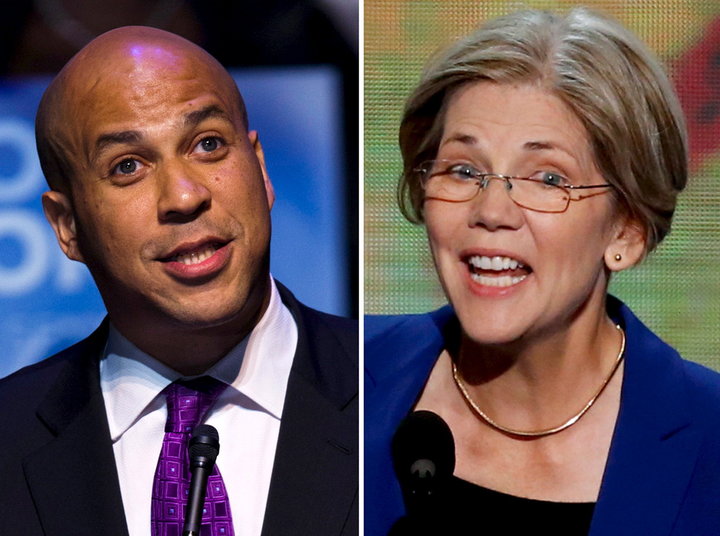
REUTERS PHOTOGRAPHER / REUTERS Senators Cory Booker and Elizabeth Warren want to improve the lives of incarcerated women.
A bill they’re sponsoring would require federal prisons to provide free tampons and pads, and would ban shackling of pregnant women.
Two Democratic senators unveiled a bill on Tuesday that aims to drastically reform how the U.S. federal prison system treats women behind bars, a segment of the incarcerated population that is often overlooked despite its rapid growth.
Sens. Cory Booker (N.J.) and Elizabeth Warren (Mass.) introduced The Dignity for Incarcerated Women Act at a press conference Tuesday. The bill, which also had Sens. Kamala Harris (Calif.) and Dick Durbin (Ill.) as co-sponsors, would require federal prisons to provide free, quality sanitary napkins and tampons to female inmates, and would ban shackling them during pregnancy or placing pregnant women in solitary confinement.
At the heart of the bill are proposals that would make it easier for women to maintain strong family ties with their children while in prison. It requires that the Federal Bureau of Prisons consider the location of children when deciding where to place an inmate, and to create policies that make it easier for inmates to communicate with their families. These include longer and more frequent visiting hours, allowing physical interactions during visits, and not charging for phone calls.
“It is in the societal interest to support families when members of those families are incarcerated,” Booker told HuffPost. “We do unnecessarily harsh things that are not necessary for public safety, but really punish women and punish their families as a whole.”
Men make up the bulk of America’s imprisoned population, but the number of women behind bars has soared over the past few decades to more than 200,000 as of 2014, and women are now the fastest growing segment. (Compared internationally, the U.S. incarcerates women at a higher rate than every country but Thailand).
The legislation would affect the nearly 12,695 women in federal prisons ― almost 60 percent of whom were convicted of drug offenses ― but not those in state prisons and local jails, where the majority of women are held.
The bill comes at a time of growing national concern about the need for criminal justice reform. While most of the discussion focuses on men, the popular Netflix show, “Orange Is The New Black,” has highlighted the plight of women behind bars, and touched on many of the issues that the bill seeks to address: a lack of proper access to feminine hygiene products, the trauma histories of the inmates, and the difficulty of parenting from prison.
We need to create a prison that, yes, is holding people accountable, and yes, is allowing people to pay their debt to society for mistakes they have made, but also is about the dignity of humanity.
Sen. Cory Booker
While many prisons do provide a limited amount of feminine hygiene products, they are often of poor quality and not useful. That means women are in the uncomfortable situation of either having to ask correctional officers for more ― which can be demeaning and raise the risk of abuses ― or use limited funds to buy them at the commissary.
“Considering the fact that 72% were living in poverty prior to being incarcerated, that often isn’t feasible,” said Jesselyn McCurdy, senior legislative counsel at the ACLU.
In 2008, the Federal Bureau of Prisons announced it would no longer shackle pregnant women during labor. But women are still allowed to be shackled while pregnant, which the bill would prohibit.
The legislation was met with approval by prison reform advocates.
“This bill could mark a profound shift toward treating people within our prisons as whole and feeling humans with a desire to do better for themselves and their families,” said Diana McHugh, director of communications for the New York-based Women’s Prison Association. “We hope to see similarly well-informed policies at the city and state level, as well as a general shift toward alternatives to incarceration that promote public safety without prison.”
Judith Resnik, a professor at Yale Law School, said that while the bill would provide an important step forward, sentencing reform is also needed. “Many women are over-incarcerated,” she said.
Booker said women in prison are “in need of therapy, in need of healing, and in need of support,” and called the criminal justice system profoundly unjust.
“We need to create a prison that, yes, is holding people accountable, and yes, is allowing people to pay their debt to society for mistakes they have made, but also is about the dignity of humanity,” he said. “We’ve got to be a better society than this.”
This article has been updated to reflect that Sens. Durbin and Harris signed on as sponsors late Monday prior to the introduction of the bill.
Criminal justice reform desperately required, especially for women incarcerated in Alabama
Alabama’s criminal justice system is in crisis. Mass incarceration, severe prison overcrowding, budget-busting costs and unfair sentencing have created conditions and practices that threaten the state’s resources and basic human rights. Alabama’s criminal justice system has marginalized thousands of residents and devastated many poor and minority communities while failing to improve public safety in any appreciable way. Many criminal justice policies have contributed to endemic hopelessness and dysfunctional and criminal behavior and have proven to be very ineffective.
The costs of many criminal justice policies have additionally created a fiscal crisis. Education spending and state planning and development have been undermined by out-ofcontrol prison costs and financial demands generated by sentencing policies and misguided practices.
These problems have been fostered by a lack of information and critical analysis and shielded by a legal and political culture that is fearful of sensible reform unless it appears “tough on crime.” This report provides a critical assessment of many criminal justice issues in the hope that more informed debate, dialogue and decision-making can take place in Alabama.
This report addresses sentencing, probation, prison conditions and parole in Alabama. Alabama’s sentencing laws, ineffective use of probation, unregulated and politicized parole procedures and an underfunded prison system have conspired to create one of the highest incarceration rates in the world. The consequences are devastating for poor people and people of color as well as Alabama’s economic, social and political health. Alabama’s political and legal culture allows politicians to use prisons and punishment to manage social and health care problems. This ill-advised approach has resulted in record deficits and a fiscal crisis that creates both a serious threat to public welfare and an opportunity for significant reform.
A federal court ruled yesterday that Alabama fails to provide constitutionally adequate mental health care to people in state prisons, finding that mental health services are “horrendously inadequate” and have led to a “skyrocketing suicide rate” among incarcerated people.
In a 302-page opinion, the court detailed “serious systemic deficiencies,” including the failure to identify prisoners with serious mental health needs and inadequate treatment for suicidal prisoners. It found that Alabama prisons discipline mentally ill prisoners for the symptoms of their illnesses and segregate them for prolonged periods. Rather than providing effective treatment, Alabama prisons are “warehousing” the mentally ill, the court wrote.
Evidence presented during a two-month trial that ended in February demonstrated that the state has shown “deliberate indifference” to the unconstitutional conditions in state prisons. “Officials admitted on the stand that they have done little to nothing to fix problems on the ground, despite their knowledge that those problems may be putting lives at risk,” the court found.
The court further found that “staffing shortages, combined with persistent and significant overcrowding, contribute to serious systemic deficiencies in the delivery of mental-health care.” Alabama is an outlier in its refusal to enact meaningful sentencing reforms to address its prison overcrowding crisis, and so the state’s prisons continue to hold double (190 percent) their design capacity and have the highest inmate-to-officer ratio in the country.
During the trial, Jamie Wallace testified about the Department of Corrections’s failure to provide him with treatment, telling the court he received only minimal attention from mental health staff even when he was on suicide watch. Less than a month after he testified, Mr. Wallace died by suicide, alone and unmonitored in his prison cell. The court wrote that Mr. Wallace’s case “is powerful evidence of the real, concrete and terribly permanent harms that woefully inadequate mental-health care inflicts on mentally ill prisoners in Alabama.”
The court ordered the parties to discuss a remedy, emphasizing that “given the severity and urgency of the need for mental-health care explained in this opinion, the proposed relief must be both immediate and long term.”
The ruling caps the second of three phases of a lawsuit filed in 2014 by the Southern Poverty Law Center, the Alabama Disabilities Advocacy Program, and the law firms Baker Donelson, and Zarzaur Mujumdar & Debrosse.
“For far too long, Alabama prisons have been little more than warehouses where many people struggling with mental illness have been hidden away and abandoned by the state,” said Lisa Borden, an attorney with Baker Donelson. “Once locked behind prison walls, in deplorable conditions with little or no treatment, any hope for improvement or recovery was lost, and many became more profoundly ill. We look forward to now having the opportunity for our clients to receive real treatment for their illnesses, and to seeing them afforded the basic dignity to which any human being is entitled.”
The lack of mental health care in Alabama’s prison system is representative of broader systemic failures that subject inmates to unconstitutional conditions. EJI’s federal class action lawsuit on behalf of prisoners at St. Clair Correctional Facility challenges the corrections department’s failure to remedy violent conditions there, and violence, abuses, and poor conditions throughout the state prison system prompted an investigation by the U.S. Department of Justice.
By David Wise,who retired as warden of St. Clair Correctional Facility after 28 years with the Alabama Department of Corrections.
With less than a week left in Alabama’s Legislative Session, our lawmakers are rushing to pass a bill calling for construction of four new prisons – three men’s facilities paid for by local municipalities and leased to the Department of Corrections and one women’s facility built by the state.
David Wise
Why are our lawmakers in such a hurry to put lipstick on a pig?
Facilities are not the main problem plaguing Alabama’s criminal justice system; proper funding and staffing necessary to run our prisons constitutionally and humanely are. Bricks and mortar should not take precedent over resources needed to provide adequate security, medical and mental health treatment, and protection to the public.
I retired after 28 years with the Alabama Department of Corrections, working my way through the ranks at four different facilities and the Training Division. I started my career at St. Clair in 1983 – the year it opened – and ended it there as warden.
I know what it takes to successfully run a prison: proper staffing, adequate funding, legislative support, gubernatorial leadership, and a DOC commissioner who advocates and implements change.
We can’t just lock people up and forget about them. We must take care of them. That requires better training for correctional officers, more programming to keep prisoners from idle time that can lead to violence, and quality medical and mental health care.
I agree that some of our facilities could stand to be replaced. But before we spend millions of dollars on new prisons, there are cosmetic repairs and security enhancements that could be made at a fraction of the cost to improve prison conditions and the environment for both prisoners and staff.
Alabama’s prisons are dangerously understaffed with only half as many correctional officers as needed. Starting salaries are lower than other competing law enforcement jobs, the work environment is unsafe with an abysmal officer to prisoner ratio, and mandatory overtime often requires officers to work double shifts.
Better staffing, better pay and better training are all more critical than new prison facilities.
ADOC Commissioner Jeff Dunn has said the four new facilities will be so nice that the obstacles of recruiting and retaining officers will be solved. That makes no sense. Unless the state can boost the starting salary for correctional officers by about $7,000 – on par with starting salaries of state troopers, police officers, and sheriff’s deputies – facilities will remain understaffed, the state will continue to shell out millions in overtime pay, and violence will continue to plague our prisons.
The state claims that the new prison plan, which caps bonds at $845 million and would cost more than $1 billion to pay back, will pay for itself with somewhere between $40 to $50 million in annual savings. A majority of the projected savings comes from reduction in staff and overtime spending. That doesn’t add up. If we fully staff our prisons with competitive wages, those savings won’t be realized. If we fail to fully staff our prisons, overtime pay won’t be saved. Either way, Alabama taxpayers will be left paying for these new prisons.
Another area of predicted savings comes from reduced healthcare expenses.
The Department of Corrections is facing a lawsuit filed by the Southern Poverty Law Center for unconstitutional levels of medical and mental health care. The resolution of these cases will significantly increase health care costs. To provide a constitutional-level of care, prisons are going to need additional doctors, nurses and other medical staff as well as more space to adequately treat incarcerated patients.
Shiny new buildings won’t attract more staff or provide better health care. Spending money on constructing new prisons before addressing the real problems plaguing ADOC is pointless.
I encourage our lawmakers to oppose the prison bill. We must develop a comprehensive approach to effectively fix our overcrowded, understaffed and under-resourced prisons. Doing so will take longer than a few days. After all, billions of dollars and people’s lives are on the line.
Ask congress to ensure that correctional facilities do not ban in-person visits
Sign this petition asking Congress to ensure that correctional facilities do not ban in-person visits.
Why is this important?
This petition is in support of Congresswoman Tammy Duckworth’s Video Visitation in Prisons Act, which would require the Federal Communications Commission to ensure that correctional facilities that have video visitation services do not ban in-person visits.
U.S. jails and prisons are increasingly using video visitation to replace in-person visits. Some carceral facilities have even taken measures to end in-person visits entirely. Securus, for example, a company that provides phone services and video visitation for jails, requires jails and prisons to immediately suspend in-person visits after adopting their contract.
Although video visitation is an important option for people with physical illnesses, disabilities, and limited time and finances, in-person prison visits help incarcerated people to maintain vital relationships with their family members and loved ones on the outside. Face-to-face jail and prison visits are one of the few available opportunities for connection granted to people locked behind bars. We must protect this basic human right.








 Montgomery Women's Facility
You must be logged in to post a comment.