Why Are So Many Black Women Dying of AIDS?

The injustices caused by racial profiling in law enforcement, and bias in criminal prosecution and sentencing, are now a subject of significant public attention. And they should be. The loss of life and liberty from these practices is shameful and tragic. But it is critical that we do not overlook the significant evidence showing that the end result of these practices — the mass incarceration of nonwhite men — may also be fueling an urgent public health crisis among some of the most disadvantaged members of our society.

Although African-Americans represent about 12 percent of the United States’ population, they account for roughly half of all new infections and deaths from H.I.V./AIDS. The H.I.V. infection rate among black women is 20 times higher than for white women, read more http://nyti.ms/1Z4t5I9 

 

What Is Going On With Visitation?

For several months now, the process of being booked in for visitation has gone from bad to worse. We are hearing complaints from friends and family of the women who arrive 10-15 minutes early and are ready at the booking in shack, yet the correctional officers do not even bother coming over to process people in until the official start time of visitation.

Inside news from Montgomery Women's Facility
Inside news from Montgomery Women’s Facility

As of the weekend December 5th-6th, it was observed that most families and friends were inline by 10-20am on Sunday December 6th, but the officers did not appear with Lt. Mason until at least 10:30am it then took the officers almost 45 minutes to process the people in, that is totally unacceptable given that visitation is only 3 hours long.

One family member told us, “they get us in late and kick us out early”. Some people arrive with very young children and adversely some families arrive with older relatives, the correctional officers should start processing people in earlier so that people get as much time with their loved ones as possible. Visitation is vitally important for maintaining the family bond.

We suggest that people start contacting Warden Ellington with their concerns on (334) 215-0756 or the Commissioners Office, Please add your comments below, and if all else fails then contact us and we will pass on your complaint or concern.


Clarification Finally Given On PREA Laws

The women were recently issued with ADOC’s new PREA (Prison Rape Elimination Act) informational flyer. It seems they have finally started to acknowledge and clarify the law and how it legally affects the women, what protection it affords them, and what they can expect to happen should they ever feel threatened or are attacked in anyway by another inmate or a correctional officer. PREA is not a new law, but its good to see it getting formal exposure throughout the facility, inline with federal standards, although perhaps given the seriousness of the subject matter, perhaps a spelling and grammar checker should have employed before being sent to print. In any event, please note that retaliation is not permitted in any form, and there are many valid forms of reporting any and all incidents.

PREA Rules
PREA Rules at Montgomery Women’s Facility

Continue reading

Words From Prison…Did You Know???

Women In Prison An Overview

Women are the fastest growing segment of the incarcerated population. Nationally, there are now more than eight times as many women incarcerated in state and federal prisons and local jails as there were in 1980.[i]

The number of women serving sentences of more than a year grew by 757% between 1977 and 2004—nearly twice the 388% increase in the male prison population.[ii]

There are more than one million women behind bars or under the control of the criminal justice system when all forms of correctional supervision–probation, parole, jail, and state and federal prisons–are considered.[iii]

New York State has the fourth largest female prison population in the nation, exceeded only by Texas, California and Florida.[iv]
Women of color are significantly overrepresented in the criminal justice system. Two-thirds of women in prison in the United States are women of color.[v]

In 2004, black women were 4.5 times more likely than white women to be incarcerated.[vi]

African American women’s incarceration rates for all crimes increased by 800% since 1986, compared to an increase of 400% for women of all races.[vii]

Continue reading

The Cost Of Mass Incarceration

Prison system costs now account for 1 out of every 15 state general fund discretionary dollars. Criminal justice is the second-fastest-growing category of state budgets, behind only Medicaid, and 90 percent of that spending goes to prisons. We are wasting trillions of dollars on an ineffective and unjust criminal justice system. We have more effective tools for preventing and responding to crime than prisons.

Alternatives To Incarceration

Problems like mental illness, substance use disorders, and homelessness are more appropriately addressed outside of the criminal justice system altogether. Services like drug treatment and affordable housing cost less and can have a better record of success. It’s time we got serious about pulling our money out of incarceration and putting it into systems that foster healthy communities.

With almost 50% of prisoners in federal prison for a drug offense and multitudes of severely mentally ill people imprisoned, it is time for the criminal justice system to begin exploring alternatives to incarceration.

Continue reading

Women and the Criminal Justice System

Over the past 30 years, the number of women and girls caught in the criminal justice system has skyrocketed. Many have been swept up in the War on Drugs and subject to increasingly punitive sentencing policies for nonviolent offenders. There are now more than 200,000 women behind bars and more than one million on probation and parole.

Many of these women struggle with substance abuse, mental illness, and histories of physical and sexual abuse. Few get the services they need. The toll on women, girls, and their families is devastating.

Furthermore, the overincarceration and overconviction of women has devastating effects on them and their families because of the barriers women face as a result of their criminal records. These barriers include employment discrimination (compounded by the trend among employers of conducting background checks), exclusions from certain occupations (including some traditionally dominated by low-income women, such as home health care and childcare), exclusions from housing, and bans on receiving public assistance.

The ACLU is working to reduce the overincarceration of women and girls, ensure equal rights and dignity while in confinement, and eliminate barriers imposed as a result of having a criminal record.

CRUEL CONFINEMENT: ABUSE, DISCRIMINATION AND DEATH WITHIN ALABAMA’S PRISONS | SOUTHERN POVERTY LAW CENTER

Publication June 04, 2014

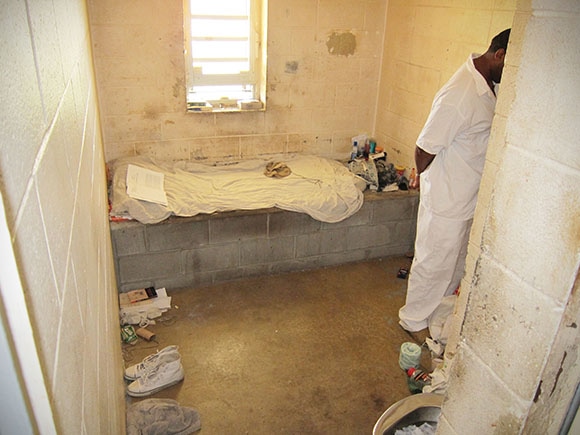
An investigation by the Southern Poverty Law Center (SPLC) and Alabama Disabilities Advocacy Program (ADAP) has found that for many people incarcerated in Alabama’s state prisons, a sentence is more than a loss of freedom. Prisoners, including those with disabilities and serious physical and mental illnesses, are condemned to penitentiaries where systemic indifference, discrimination and dangerous – even life-threatening – conditions are the norm.

Executive Summary

An investigation by the Southern Poverty Law Center (SPLC) and Alabama Disabilities Advocacy Program (ADAP) has found that for many people incarcerated in Alabama’s state prisons, a sentence is more than a loss of freedom. Prisoners, including those with disabilities and serious physical and mental illnesses, are condemned to penitentiaries where systemic indifference, discrimination and dangerous – even life-threatening – conditions are the norm.

The Alabama Department of Corrections (ADOC) is deliberately indifferent to the serious medical needs of the prisoners in its custody. Inspections of 15 Alabama prisons, interviews with well over 100 prisoners and a review of thousands of pages of medical records, depositions and media accounts – as well as the policies, contracts and reports of the department and two major contractors – lead to one inescapable conclusion: Alabama’s prisons violate federal law protecting people with disabilities and the U.S. Constitution’s ban on “cruel and unusual punishments.”