Security is not Safety: Gendered Harms in Women’s Prisons

Barbara Owen 25th May 2017 Article originally published here
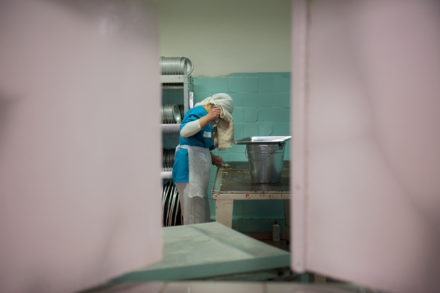
Photo: Women’s prison in Karaganda region, Kazakhstan – Karla Nur, 2014

Prisons – by definition – are secure institutions. Shifting philosophies of punishment underpin approaches to security and safety. The mobility, behaviour and activities of those imprisoned are controlled by carceral architecture and structured schedules with policy, practice and personnel reinforcing the custodial demands of imprisonment. Such procedures are designed to prevent escapes and maintain ‘control’ and ‘order’ through security and discipline. My experience in women’s prisons has led me to question this dynamic for imprisoned women: does security create safety? Are women safe while imprisoned? Does security itself create gendered harms of imprisonment?

In the last decade, my work has focused on these questions through two long-term projects. First, I was more than fortunate to be invited to work with the Thailand Institute of Justice (TIJ), a partner of PRI, in addressing the global issues of women in prison. Thailand, through the support of Her Royal Highness Princess Bajrakitiyabha, has led this charge by supporting the development of and implementing the Bangkok Rules, soft laws that offer guidance on human rights protections for women in prison (see PRI’s extensive resources on the Bangkok Rules). Second, I have explored the dimensions of gendered safety in American women’s prisons and jails with James Wells and Joycelyn Pollock through extensive interview, focus group and survey research. These experiences have steered me to question the wide gulf between security and safety – particularly as experienced by women prisoners.

Gendered Harms

As Dana Britton argues, prisons are deeply gendered organisations. In our book, In Search of Safety: Confronting inequality in women’s imprisonment, we build on this insight to examine the harms embedded in the contemporary prison and how these harms impact women differently than men. In documenting women’s experience with imprisonment, we frame these threats to women’s safety as ‘gendered harm’ in two ways. First, and most common, is the idea that harm is damage or injury to a person through overt actions or practice. Clearly, forms of physical and sexual violence against women in custody fit this view. Operational practice grounded in the need for physical security has also been shown to harm imprisoned women. The daily round in prison is often detrimental to women’s well-being, particularly for women with trauma symptoms or other mental health conditions.

Second, we also see gendered harm in terms of the inability or unwillingness to meet women’s pathway needs. Such needs are often unmet inside prison, when they fail to acknowledge the gender-based realities that shape women’s pathways to prison. Such neglect is common in women’s prisons throughout the world. There are overlapping themes relevant to women offenders: providing for their safety, rehabilitation and social reintegration while in custody, requiring that programmes and services address their gender-based needs in terms of health care (including pregnancy), mental health and other therapeutic needs; and recognising their histories as survivors of interpersonal violence, and their caring responsibilities for children. Women’s prisons may be secure but, we ask, are they safe?

We claim these harms are unnecessary and constitute gendered human rights violations. The challenges to safety and well-being of women prisoners are not only problems in America’s prisons. Globally, women in prison face many forms of discrimination and other consequences of gender inequality, reproducing the harms identical to those we find in U.S. prisons.

There are two practical solutions to this unnecessary suffering: expanding the concept of security to include multiple forms of gendered safety, and implementing the human rights protections outlined in the Bangkok Rules.

Continue reading

Pass the Video Visitation Act – H.R.6441

Campaign created by Jamani Montague
Ask congress to ensure that correctional facilities do not ban in-person visits

Sign this petition asking Congress to ensure that correctional facilities do not ban in-person visits.

Why is this important?

This petition is in support of Congresswoman Tammy Duckworth’s Video Visitation in Prisons Act, which would require the Federal Communications Commission to ensure that correctional facilities that have video visitation services do not ban in-person visits.

U.S. jails and prisons are increasingly using video visitation to replace in-person visits. Some carceral facilities have even taken measures to end in-person visits entirely. Securus, for example, a company that provides phone services and video visitation for jails, requires jails and prisons to immediately suspend in-person visits after adopting their contract.

Although video visitation is an important option for people with physical illnesses, disabilities, and limited time and finances, in-person prison visits help incarcerated people to maintain vital relationships with their family members and loved ones on the outside. Face-to-face jail and prison visits are one of the few available opportunities for connection granted to people locked behind bars. We must protect this basic human right.

Sign The Petition Now!


Raw sewage backing up and spilling onto bathroom floors

Several complaints have been made since raw sewage started backing up and flooding the bathroom floors in as many months. The Officers make the women contain the flow of effluent by placing blankets and towels under the doors. They are then made to fish out any large foreign objects like sanitary towels, from the toilet bowel by hand.

It is often days before an external contractor is called to attend and remedy the problem. Apart from the obvious health risks associated with raw sewage, flies plague the bathroom whilst the women are trying to wash and brush their teeth, having flies landing on their person and their belongings.

This is clearly a severe health risk and wrong on so many levels. If your loved one reports to you that the sewage is over flowing again, and the Officers response is indifference, please contact the Alabama Department of Public Health via this form immediately. Also, you may want you can contact Carla Ward on 205.244.2001 email USAALN.CivilRights@usdoj.gov she is a member the Department of Justice team that is investigating the appalling conditions in Alabama prisons.


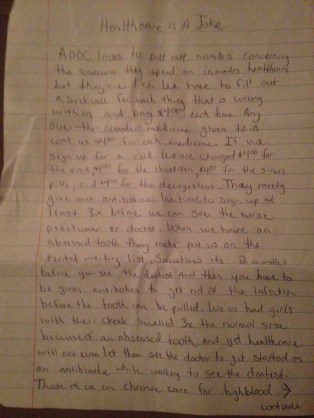
Alabama Department of Corrections Healthcare is a Joke and thats not the half of it…

Alabama Department of Corrections likes to put out numbers concerning the amount they spend on inmates healthcare, but they are lies. We have to fill out a sick call for each thing that is wrong with us, and pay $4.00 each time. Any over the counter medicine given to us costs $4.00 for each medicine.

Alabama Department of Corrections Healthcare is a Joke

For example, if we sign up for a cold, we are charged $4.00 for the visit, $4.00 for the Ibuprofen, $4.00 for the Sinus pills, and $4.00 for the decongestant. They rarely give out antibiotics. We have to sign up at least 3x before we can see the nurse practitioner or Doctor. When we have an accessed tooth, they put us on the Dental waiting list, sometimes it takes 2 months before you see the Dentist, and then you have to be given antibiotics to get rid of the infection, before the tooth can be pulled.

We’ve had girls with their cheeks swollen 3x the normal size because of an accessed tooth and yet health care will not let them see the Doctor to get started on an antibiotic, whilst waiting to see the Dentist.

Those on chronic care for high blood pressure, have to pay $4.00 if we feel that our blood pressure is up and ask to have our blood pressure checked. If you complain about the healthcare at Montgomery Women’s Facility too much, they will send you back to Tutwiler, where no one wants to go. Its their way of punishing us for speaking out against their mistreatment. We call healthcare, deathcare and most of us try to avoid their type of care.

Correctional Medical Services, which later became Corizon, held the contract from 2007 to 2012. ADOC awarded Corizon the healthcare contract in 2012, through to Sept. 30, 2017, under extension, it was the only company to submit a bid. The $181 million extension will bring the total cost of the contract to $405 million. State funds pay 100 percent of the cost. So why the hell are inmates forced to pay for each appointment despite having to wait in some cases months to see a healthcare professional and then pay extortionate prices for over the counter medicine which cost pennies in the free world and where the hell are they supposed to get the money from in the first place?

The Southern Poverty Law Center and Alabama Disabilities Advocacy Program have sued Alabama Department of Corrections, over the failure to provide adequate medical care, mental health care and accommodations for the disabled violates the constitution and federal law. Despite ADOC claiming their “healthcare” is adequate, it has agreed to improve conditions for inmates with disabilities, the lawsuit is ongoing and in fact, The SPLC, the Alabama Disabilities Advocacy Program and the law firm of Baker Donelson have asked a federal judge to certify its lawsuit against the Alabama Department of Corrections (ADOC) as a class action, which would allow rulings in the case over the inadequate medical and mental health care of 43 prisoners named in the lawsuit to apply to the 25,000 people held in a prison system that has had one of the highest mortality rates in the country.


Alabama Department Of Corrections Grievance against Officers Program

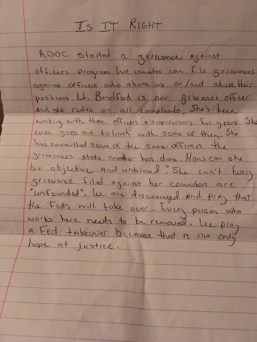
Alabama Department of Corrections started a grievance against Officers program. We inmates can file grievances against Officers who abuse us and/or abuse their positions. Lt. Bendford is our grievance Officer and she rules on all complaints. She’s been working with the same Officers and supervisors for years.

Alabama Department Of Corrections Grievance against Officers Program

She even goes out to lunch with some of them. She has committed some of the same offences that grievances state, another has done. How can she be objective and unbiased? She can’t.

Every grievance filed against her co-workers are “unfounded”. We are discouraged and pray that the Feds will take over. Every person who works here needs to be removed.

We pray a Fed takeover because that’s our only hope at justice.


Transcribed from a letter by an inmate, identity withheld in fear of retaliation

Despite talks of reform, Alabama’s prisons remain deplorable

Article Originally published here on January 09, 2017 at 3:35 PM, updated January 09, 2017 at 3:39 PM
Inmates sitting on their bunks in a dorm in Julia Tutwiler Prison in Wetumpka. (Julie Bennett/jbennett@al.com)

By Dr. Larry F. Wood, retired clinical and correctional psychologist

I spoke out on the prison reform issue two years ago after working in Tutwiler women’s prison as a prison psychologist. Even after 25 years of professional experience in prisons, I was unprepared for the immensity of the problems. In particular, mental health and medical care were severely inadequate. The administration of the prison was unprofessional and abusive. Two years ago, I described the prison environment as a culture of abuse.

In the past two years, a federal investigation has continued and a trial is under way. The State of Alabama continues to deny that the conditions are unconstitutional. No substantial improvements or program changes have been announced. Governor Bentley has focused on borrowing money to build more prisons.

I have been disappointed that little seems to have happened over the past two years. State Senator Cam Ward has spoken eloquently on the subject, but there seems to be no political will to address the problem directly.

One core of the problem is the simple overuse of imprisonment to deal with social problems other than aggressive criminality. The most extreme example is mental illness. State hospitals were closed because of abusive conditions and now, most of the seriously mentally ill in our state are in prisons. Many other inmates are intellectually inadequate, socially unskilled, or drug addicted. Many were traumatized by a lifetime of physical, emotional or sexual abuse.

Prisons were initially used to control and punish the overtly dangerous. Their role has been expanded over many years to include the chronically disruptive in society. Such people are arrested numerous times and are backed up in county jails, waiting for beds to house them in prison. Prison, as a punisher, is not appropriate or effective for many such inmates.

Simply stated, Alabama’s prisons are overcrowded because too many people are being held in expensive, high security lockups. If our prisons were reduced to recommended population levels, they could be operated safely and professionally. Minimum security facilities with focused treatment and programs would be far less expensive than prisons for most inmates.

Continue reading

Dormitory Representatives Meeting Notes

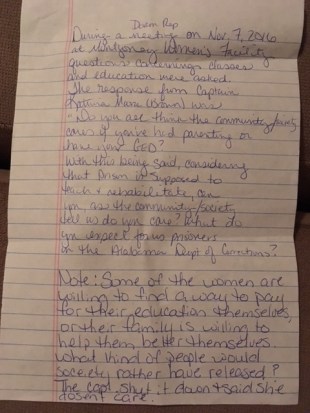
During a meeting on November 7th 2016 at Montgomery Women’s Facility, questions concerning classes and education were asked. The response from Captain Katrina Moore (Brown) was “No you all think the community/society cares if you’ve had parenting or have your GED?”

With this being said, considering that prison is supposed to teach & rehabilitate, can you, as the community/society tell us, do you care? What do you expect for us prisoners in the Alabama Dept of Corrections?

Note: Some of the women are willing to find a way to pay for their education themselves, or their family is willing to help better themselves. What kind of people would society rathe have released? The Capt. Shut it down & said she doesn’t care.

Transcribed from a letter by inmate T, identity withheld for fear of retaliation
Dormitory Representatives Meeting Notes

Good behavior often goes overlooked in prison

Out of approximately 300 women that are held in Montgomery Women’s Facility, its estimated that 80% are active drug users. This includes smokers of Marijuana and Spice, alcohol can be obtained and even intravenous drugs are acquired and consumed.

How is this right? How is this allowed or even possible you may well justifiably enquire? The answer is insidiously simple. The officers know who the troublemakers are and they tend to let them get away with illicit activities to keep the peace among the inmate population. Inmates who maintain model conduct in order to have an impeccable institutional record are unable to distinguish themselves in any significant way because the correctional officers pays them no mind. Simply put, It doesn’t pay to be good.

Good behavior often goes overlooked in prison. Let me re-state that again, Good behavior often goes overlooked in prison.

Women bond in groups, some women adopt a “state child”,  often younger inmates they show the ropes to, someone that they can share their experiences with and they help to steer them out of troubles way, they show them how to adapt and to maintain some semblance of a normal life during their incarceration, they get called mom, it builds that family unit so often craved, caused by the want and desire of being a parent, but being absent from their own biological offspring. Some officers have “state children”too, that they use to do their bidding.

Some women become “gay for the stay” entering into relationships, not always sexual, but a relationship none the less, often fulfilling the role desperately sought outside of prison walls, some women revel in the limelight, being wanted, desired, cared for, provided for…some will engage in sexual activities, some will have sex with officers, after all, they know the best times and the best places in order to make it happen, in some cases its exciting, for some its done for extra privileges or extra canteen purchases, for most, they are a pawn in a game of abusive power. Knowing which groups to socialise with and those which should be avoided at all costs soon becomes apparent and before long you will probably find yourself having to choose, before the decision is made for you.

Montgomery Women’s Facility is considered a work camp although it does hold women up to the medium custody level. That means that it used to be considered a privilege to serve your time there. Approximately 10-15% of the women there go to work everyday in regular jobs. They work in fast food restaurants, hotels and the like. Alabama Department Of Corrections (ADOC) charges each inmate that works, $5 per day for the ride to work in one the several vans. The van can hold approximately 13 inmates, thats a lot per day just in van rides. Then ADOC takes 40% of the net pay inmates salary, in order to recuperate court costs, fines and restitution.

Continue reading

Mental illness and depression – An untitled letter from an inmate at Montgomery Women’s Facility

In the middle of a major breakdown…while attempting to quit smoking…I was trying to hear the voice of God…I wanted to hear “I love you”…Instead i hear the laughter of demons, taunting me…telling me that i am not loved…I am alone, I am forgotten…God is not real…look around…These women have been crying out to him for years…decades…Do you truly believe he’ll come to rescue you?

Mental illness and depression - An untitled letter from an inmate at Montgomery Women's Facility
Mental illness and depression – An untitled letter from an inmate at Montgomery Women’s Facility

He has yet to answer their call for help…You are ugly, unwanted, stupid, evil and poor…You are lower than any bit of scum on the earth. When the Officer yelled at me, I snapped…Instantly…I went back to hiding behind the couch…watching my dad scream at my mom and choke her, mercilessly…I tried to isolate myself to prevent this from happening…I tried to free my mind from the demons that held it hostage…I tried to rid myself of the memories of my dead best friend and her brutal murder…

I tried to lift myself out of depression caused by hearing my little sisters call for help…She’s homeless with a 7 year old and a 2 week old baby…She’s also trying to heal from the abuse from her new borns father…I don’t understand…Why do we have to pay for everything we’ve done wrong? Why do we have to pay for the pain that others have caused us? My dad doesn’t have to pay for abusing me, my siblings and my mom…my dad’s sister doesn’t have to pay for molesting me when i was 4 years old…The 2 men that raped me while i was drunk don’t have to pay…The man that raped and sodomized me doesn’t have to pay either…I do. And i continue to lose while paying big.

It doesn’t matter what i do…good or bad. I never win. I keep trying to move forward from the past…Its hard…These Officers are paid to make sure I’m “Safe and secure” but, they only come for one reason and one reason only: To abuse me, continually. I have no room for error, their rules change constantly and each Officer has their “Personal” set of rules…90% of the staff is authoritarian, so even asking them for a basic need angers them…They’ll just start barking commands. Theres nowhere to run, hide or turn…Mental health will only keep telling me I’m “Psychotic”…Im safest in my bed…The very place my soul began to die…The only thing i can do is pray the same prayer I’ve prayed, way before i thought about committing a crime: “Dear Jesus, please take my life…I don’t want to be selfish and take my own life, so please Lord, let me die…Amen”.

Letter transcribed by admin