Despite talks of reform, Alabama’s prisons remain deplorable

Article Originally published here on January 09, 2017 at 3:35 PM, updated January 09, 2017 at 3:39 PM
Inmates sitting on their bunks in a dorm in Julia Tutwiler Prison in Wetumpka. (Julie Bennett/jbennett@al.com)

By Dr. Larry F. Wood, retired clinical and correctional psychologist

I spoke out on the prison reform issue two years ago after working in Tutwiler women’s prison as a prison psychologist. Even after 25 years of professional experience in prisons, I was unprepared for the immensity of the problems. In particular, mental health and medical care were severely inadequate. The administration of the prison was unprofessional and abusive. Two years ago, I described the prison environment as a culture of abuse.

In the past two years, a federal investigation has continued and a trial is under way. The State of Alabama continues to deny that the conditions are unconstitutional. No substantial improvements or program changes have been announced. Governor Bentley has focused on borrowing money to build more prisons.

I have been disappointed that little seems to have happened over the past two years. State Senator Cam Ward has spoken eloquently on the subject, but there seems to be no political will to address the problem directly.

One core of the problem is the simple overuse of imprisonment to deal with social problems other than aggressive criminality. The most extreme example is mental illness. State hospitals were closed because of abusive conditions and now, most of the seriously mentally ill in our state are in prisons. Many other inmates are intellectually inadequate, socially unskilled, or drug addicted. Many were traumatized by a lifetime of physical, emotional or sexual abuse.

Prisons were initially used to control and punish the overtly dangerous. Their role has been expanded over many years to include the chronically disruptive in society. Such people are arrested numerous times and are backed up in county jails, waiting for beds to house them in prison. Prison, as a punisher, is not appropriate or effective for many such inmates.

Simply stated, Alabama’s prisons are overcrowded because too many people are being held in expensive, high security lockups. If our prisons were reduced to recommended population levels, they could be operated safely and professionally. Minimum security facilities with focused treatment and programs would be far less expensive than prisons for most inmates.
Continue reading

Dormitory Representatives Meeting Notes

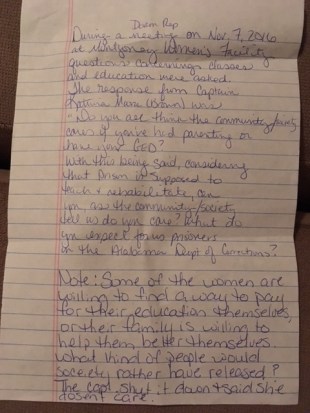
During a meeting on November 7th 2016 at Montgomery Women’s Facility, questions concerning classes and education were asked. The response from Captain Katrina Moore (Brown) was “No you all think the community/society cares if you’ve had parenting or have your GED?”

With this being said, considering that prison is supposed to teach & rehabilitate, can you, as the community/society tell us, do you care? What do you expect for us prisoners in the Alabama Dept of Corrections?

Note: Some of the women are willing to find a way to pay for their education themselves, or their family is willing to help better themselves. What kind of people would society rathe have released? The Capt. Shut it down & said she doesn’t care.

Transcribed from a letter by inmate T, identity withheld for fear of retaliation
Dormitory Representatives Meeting Notes

No Warden, No Classification Officer and Now, No Canteen Lady

Montgomery Women’s Facility has been without a full time Warden since Mr Edward Ellington left to take over at Draper Correctional Facility in March 2016. Wardenship passed temporarily to Warden Terrance during which time conditions within the facility took a drastic turn for the worse, Ms Terrance left in August and the Captain has been acting as warden since.

Alabama Department of Corrections staffing woes and their impact, are still negatively felt throughout all aspects of ADOC, it has been reported that at other facilities, Correctional Officers have gone on strike citing the dangerous conditions that are festering as the upper echelons of Alabama Department of Corrections struggle to get a grip on a system that is failing from the top all the way down. Its not just an issue of safety and security, the absence of a classification officer as at Montgomery Women’s Facility increases stress, tension and creates an additional bottleneck in an already dangerously over crowded prison system, people that have served their sentences, especially those that are considered long-timers should be high on the list of priorities as they approach their parole and end of sentence dates.

Classification Officers are supposed to interview and assess amongst other things the custodial level biannually, effectively allowing those that have a low enough custody level, to be able to work and be in preparation for their release. Having no classification officer is a serious issue and it keeps women held on higher custodial levels than which they are entitled too, in an already over populated, neglectful and abusive prison system, common sense you would have thought, would be a priority, facilitating the lowering of custodial levels to those eligible, effectively freeing up bed space and hastening the transition back into society, not to mention raising moral, giving hope to those that have often served many years from dubious convictions.

Bear in mind too, that Alabama cases are difficult for many reasons, for example Post-conviction records are exceptionally hard to obtain in Alabama, and there is no specific post-conviction DNA testing statute except in capital cases. New evidence often must be brought before a court within six months of discovery, which can be extremely difficult and at times, impossible. Alacourt.com controls public court records in Alabama and charges exorbitant access fees, making the records virtually inaccessible to those incarcerated or their families which are generally on low incomes, Alabama needs to rethink its policy on locking people up and throwing away the keys, giving fair hearings, trials and sentences would be a great start.

Continue reading

When Defense Lawyers Become Prosecutors

By J. Celso Castro Alves, Truthout | News Analysis

Scales of Justice weigh heavily against Defendants in Alabama

In theory, a public defender’s mission includes dedicated advocacy for clients against whom the power of the carceral state is mobilised. In theory, a public defender’s mission includes dedicated advocacy for clients against whom the power of the carceral state is mobilized. However, in practice, defenders sometimes end up working with the forces of power — and against the best interests of their clients. (Photo: Pixabay)

On January 5, 2015, Randall H. McCants Jr. was not alone when Judge James H. Roberts Jr. of the Sixth Judicial Circuit of the State of Alabama opened his courtroom for a plea hearing. “Mr. McCants is present in court with his attorneys, Jim Gentry and Mike Cartee,” he stated. Besides the judge’s reference to McCants’ court-appointed attorneys by their nicknames, nothing appeared out of the ordinary. Roberts cited McCants’ constitutional rights before highlighting his defense attorneys’ central task: “Your attorneys are bound to do everything they can honorably and reasonably do to see that you obtain a fair and impartial trial.” McCants answered the judge’s questions with “yes, sir” and “no, sir.” Even to the charge of capital murder and the question of whether he understood that “the range of punishment is life without parole or death,” McCants responded, “yes, sir.”

According to the nine-page hearing transcript, Roberts knew that McCants had pled not-guilty during his post-arrest arraignment in January 2011. In fact, Roberts acknowledged that McCants’ attorneys had only recently “proposed a plea agreement” for the “lesser offence of murder.” Yet, at no point during the hearing did Roberts wonder about what prompted McCants’ sudden about-face. Did four mysterious years in pretrial detention impact McCants’ decision? Could McCants’ attorneys have coerced him to plead guilty by invoking fear that a greater punishment awaited him at trial? Whether McCants was mentally competent to grasp legal proceedings or understand that he was assuming full responsibility for the accidental death of a Tuscaloosa resident apparently did not cross Roberts’ mind either.

Rather, Judge Roberts proceeded with the plea colloquy by asking prosecutor Jonathan S. Cross to provide “some facts” for the first-degree murder plea. Compliant, Cross stood and delivered some skimpy facts in the most casual and sloppy fashion possible:

Continue reading

The Forgotten

I sit back and watch things that go on. I use to stand up at the injustices and the wrongs done by officers, but retaliation against me for so long, i say nothing. I wonder if we are forgotten, or does society even care that we suffer abuse behind bars. There are plenty of female inmates that are here for drug convictions or robbery or theft of property and a lot get out after 5 years or less and keep breaking the law and keep coming back to prison.

The Forgotten - an inmates statement regarding the criminal judicial system in Alabama.
The Forgotten – an inmates statement regarding the criminal judicial system in Alabama and how it treats “violent female offenders” versus the “non-violent repeat offenders”.

And there are plenty of us who are here for defending our lives or that of our children, and by taking a life that was a threat to us or our loved ones, we forfeit our freedom and removed from our families. We are rarely ever given another chance at living in society, yet we are the ones who won’t commit another crime and keep returning to prison. We are not the ones society should fear. We don’t get high on drugs and break into your home to steal.

We are guilty of murdering one who was threatening to kill us. On those rare occasions when we are given another chance at society, we don’t come back, we don’t prey on society. We appreciate our new freedom because we have lost so much. Society shouldn’t worry about female violent offenders. 9 times out of 10, the person we killed was an abusive husband or boyfriend. It’s easy to judge us, but until your life or your children’s life has been threatened, you have no idea what you are capable of doing. The ones society should worry about granting parole to and the ones who get a slap on the hand with light sentences are the nonviolent offenders, society drug users and drug dealers. Society should fear these women. They will prey on your Mom & Dad, your sister and brother, your grand parents, your children.

The prison door is a revolving door for them. For us who are here for murder in self defence, serve our whole sentences and are rarely granted parole and those with life sentences end up dying in prison. We are locked up and forgotten and yet we are the least dangerous, the least of society’s worries.

Transcribed by admin, inmates name withheld in fear of retaliation


Air Conditioning Is a Human Right

Jeff Edwards and Scott Medlock July 21, 2016
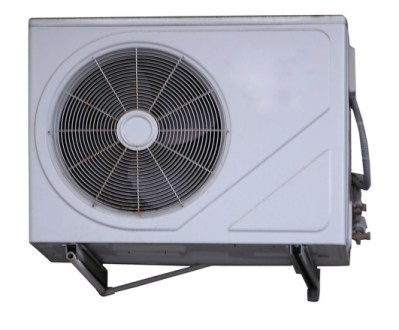
Air Conditioners are desperately needed throughout Alabama's prison system
Air Conditioners are desperately needed throughout Alabama’s prison system

Edwards and Medlock are trial lawyers with Edwards Law in Austin.

Texas, like other states, does not air condition its prisons—and by doing so, it kills people.

In 2011, the State of Texas convicted Larry McCollum of forgery, for passing a bad check. He was supposed to serve a short prison sentence of two years, then go home to his family. Instead, the conditions inside Texas prisons gave him a death sentence. He died of heat stroke—indoors.

Over 120,000 beds in the Texas Department of Criminal Justice system do not have air conditioning, including the Hutchins State Jail near Dallas, where Mr. McCollum was imprisoned. As a result, the indoor heat index—the combination of temperature and humidity—frequently exceeds 100 degrees on hot summer days. Shortly before Mr. McCollum died, the Hutchins’ warden received multiple emails from the risk manager, who took a thermometer around to the dorms, stating the temperature inside the inmate dormitories reached 102 degrees by early afternoon, and that the heat index inside was likely 123. While Mr. McCollum baked inside his dormitory, his body temperature rose to 109.4. Eventually, his body began to seize, and he was hospitalized. When his wife and adult children were summoned, they learned his body temperature had permanently damaged his brain, and he would not survive.

According to the National Weather Service, in an average year, heat kills more people than floods, lightning, tornadoes and hurricanes combined. In all, during the past 18 years, over 20 men have died with the cause of death of heat stroke inside prison buildings constructed and maintained by the State of Texas. Though the count is likely much higher: When temperatures go over 90 degrees, the medical risk of heat stroke increases markedly, and it can lead to other causes of death, especially for people with certain common medical conditions like diabetes, high blood pressure, or asthma, or who take certain medications, including most mental health prescriptions.

Continue reading

Fears For Inmates Health as Summertime Temperature’s Soar

No More Heat Deaths
No More Heat Deaths

Nation Inside is hearing reports from prisoners and families across the country regarding abusive heat conditions, an issue of life and death as summer rolls in and climate disruption brings triple digit temperatures. Let’s protect those inside by putting the pressure on prison officials to fix oppressive heat conditions.

Hundreds of prisons, jails, and detention centers are already sweltering. Where facilities fail to take appropriate measures to cool inmates, there will be illness, needless suffering and death. Exposing those inside our nation’s prisons to lethal temperatures is wrong. It’s unconstitutional —amounting to a form of cruel and unusual punishment—and a violation of basic human rights. Help those inside by joining the national “Stop the Heat” campaign.

Far too often, non-air-conditioned cells are also overcrowded, putting lives in jeopardy.According to a Columbia University report, members of the prison population have a number of risk factors “including advanced age, poor mental and physical health, and the use of medications,” that make them especially vulnerable to hyperthermia and other heat related conditions. The 300 women held in Montgomery Women’s Facility in Alabama, are housed in an uninsulated tin shed, in which the doors are kept closed and they have only several fans circulating the hot air within. Summertime in the South is hot, with the average temperature being in the high 90’s with high humidity.

Continue reading

The warden refuses to listen to cries for help.

I was just released form the Montgomery Women’s Facility yesterday, 06/07/2016. The medical staff there has got to be the worst in the world. I spent 1 1/2 years in pain and sick only to find out last month I had “some kind” of mass in my side. I was given meds that I was allergic to, causing serious side effects. I have witnessed individuals become ill and need immediate attention and told to put in a sick call.

The heat inside the warehouse is over 100 degrees as we speak. Yet when organizations offer to donate a/c systems they are turned down even though women are falling out with heat exhaustion. Rules change not just on a daily basis but on the same shift from officer to officer. Why? Because the officers are allowed to run this camp, not a warden.

This facility is supposed to be for work release, yet over half are not. This facility currently houses 300 people in an 75 x 95 tin building. It is filthy, over run with rats, roaches and flies. The septic system must be emptied at least once a month and the fumes are toxic. There is a constant gas leak outside the building that causes nausea and head aches.

The water is from the prison next door and is constantly being shut off. State jobs are not assigned to age appropriate individuals. Often women over 50 will be put on outside/inside grounds working harder than some men. Not only are women punished for infractions with write ups they then must do extra duty. Does not matter if you are smoking in an unauthorized area or have a dirty urine the punishment is the same.

Continue reading

Why we should close women’s prisons and treat their crimes more fairly

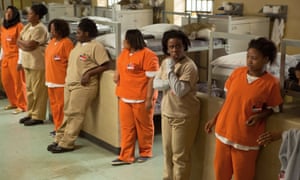
Photograph: K C Bailey/NetflixImage from Orange Is The New Black

‘Nearly every incarcerated woman is the victim of a perverse and lazy policy disfigurement that fails to acknowledge the marked differences between female and male offenders.’

By  and originally published by the guardian
 Professor Mirko Bagaric is the Director of the Centre for Evidence-Based Sentencing at Deakin University, Melbourne. Wednesday 1 June 2016 

Women almost never scare us; commit random acts of serious violence; violate our sexual integrity; or form organised crime networks and yet their prisons numbers are now the highest in recorded history.

The homogeneity of the human species breaks down when it comes to criminal behaviour. Women, who constitute slightly more than 50% of population, commit only about 20% of all crime. They commit even a lower portion of all serious crime.

Hillary Clinton is right to assert that the sentencing system should be reformed to reduce the growing number of female prisoners but the changes should go much further than has been suggested. We should implement concrete targets to remove the stains on our landscape and societal ethic that are women’s prisons.

There are remarkably similar patterns of female offending and incarceration in the United States and Australia. In the United States women commit only 17% of felonies, while in Australia they commit about 13% of the crimes dealt with in the higher courts.

Moreover, when it comes to sexual offences, rounded off to the nearest whole number, women constitute 0% of all offenders – that’s right, zero. The crimes they most commonly commit are drug and property offences. Thus, in the US, approximately 30% of female prisoners are incarcerated for property offences, and a further 26% for drug offences. The percentages for these offences are 26% and 17%, respectively, in Australia.

Women do of course commit homicide offences, but nearly always the victim is a relative and the crime was committed against the backdrop of an abusive relationship or depressive mindset. All homicides are heinous crimes but the types of homicides committed by women rarely involve random victims and hence do not engender community fear.

Despite this, the rate of female incarceration in both the United States and Australia is on the increase – far outstripping the increase in male incarceration levels. Women now comprise 8% of prisoners in the United States and Australia, which amounts to more than 200,000 incarcerated inmates in the US and 3,000 in Australia.

Nearly every one of these incarcerated women is the victim of a perverse and lazy policy disfigurement that fails to acknowledge the marked differences between female and male offenders. The differences are so stark that not only should women be treated more leniently because they commit less serious crime but they should also be treated more leniently when they commit the same crime as a man.

There are four major differences between male and female offenders.

Continue reading