Failing to pay your water bill should not be a crime

Chickasaw resident Sonya Ayers

A city ordinance that criminalized the failure to pay a water bill was repealed by the city council in the town of Chickasaw, Alabama, last night in response to a Southern Poverty Law Center letter advising the city’s municipal judge that the ordinance is unconstitutional.

Chickasaw resident Sonya Ayers, 48, was convicted of a misdemeanor and ultimately jailed last year for more than a day after she was unable to pay her city utility bill.

Her water was turned off and she was ordered by the municipal court to pay more than $400 in fines and fees to the city. She also had to pay monthly supervision fees to Judicial Correction Services, a private, for-profit probation company. Ayers could not keep up with the payments and was arrested after failing to appear at a court hearing that she was not informed about.

“Failing to pay your water bill should not be a crime,” said Sam Brooke, SPLC deputy legal director. “Yet this is exactly what happened in Chickasaw with an unconstitutional ordinance that harshly punished people for their poverty.

“The action by the Chickasaw City Council will ensure that residents will not be prosecuted or face criminal penalties when they simply cannot afford to pay for running water in their homes. It’s a step in the right direction.”

Continue reading

When Defense Lawyers Become Prosecutors

By J. Celso Castro Alves, Truthout | News Analysis

Scales of Justice weigh heavily against Defendants in Alabama

In theory, a public defender’s mission includes dedicated advocacy for clients against whom the power of the carceral state is mobilised. In theory, a public defender’s mission includes dedicated advocacy for clients against whom the power of the carceral state is mobilized. However, in practice, defenders sometimes end up working with the forces of power — and against the best interests of their clients. (Photo: Pixabay)

On January 5, 2015, Randall H. McCants Jr. was not alone when Judge James H. Roberts Jr. of the Sixth Judicial Circuit of the State of Alabama opened his courtroom for a plea hearing. “Mr. McCants is present in court with his attorneys, Jim Gentry and Mike Cartee,” he stated. Besides the judge’s reference to McCants’ court-appointed attorneys by their nicknames, nothing appeared out of the ordinary. Roberts cited McCants’ constitutional rights before highlighting his defense attorneys’ central task: “Your attorneys are bound to do everything they can honorably and reasonably do to see that you obtain a fair and impartial trial.” McCants answered the judge’s questions with “yes, sir” and “no, sir.” Even to the charge of capital murder and the question of whether he understood that “the range of punishment is life without parole or death,” McCants responded, “yes, sir.”

According to the nine-page hearing transcript, Roberts knew that McCants had pled not-guilty during his post-arrest arraignment in January 2011. In fact, Roberts acknowledged that McCants’ attorneys had only recently “proposed a plea agreement” for the “lesser offence of murder.” Yet, at no point during the hearing did Roberts wonder about what prompted McCants’ sudden about-face. Did four mysterious years in pretrial detention impact McCants’ decision? Could McCants’ attorneys have coerced him to plead guilty by invoking fear that a greater punishment awaited him at trial? Whether McCants was mentally competent to grasp legal proceedings or understand that he was assuming full responsibility for the accidental death of a Tuscaloosa resident apparently did not cross Roberts’ mind either.

Rather, Judge Roberts proceeded with the plea colloquy by asking prosecutor Jonathan S. Cross to provide “some facts” for the first-degree murder plea. Compliant, Cross stood and delivered some skimpy facts in the most casual and sloppy fashion possible:

Continue reading

The Forgotten

I sit back and watch things that go on. I use to stand up at the injustices and the wrongs done by officers, but retaliation against me for so long, i say nothing. I wonder if we are forgotten, or does society even care that we suffer abuse behind bars. There are plenty of female inmates that are here for drug convictions or robbery or theft of property and a lot get out after 5 years or less and keep breaking the law and keep coming back to prison.

The Forgotten - an inmates statement regarding the criminal judicial system in Alabama.
The Forgotten – an inmates statement regarding the criminal judicial system in Alabama and how it treats “violent female offenders” versus the “non-violent repeat offenders”.

And there are plenty of us who are here for defending our lives or that of our children, and by taking a life that was a threat to us or our loved ones, we forfeit our freedom and removed from our families. We are rarely ever given another chance at living in society, yet we are the ones who won’t commit another crime and keep returning to prison. We are not the ones society should fear. We don’t get high on drugs and break into your home to steal.

We are guilty of murdering one who was threatening to kill us. On those rare occasions when we are given another chance at society, we don’t come back, we don’t prey on society. We appreciate our new freedom because we have lost so much. Society shouldn’t worry about female violent offenders. 9 times out of 10, the person we killed was an abusive husband or boyfriend. It’s easy to judge us, but until your life or your children’s life has been threatened, you have no idea what you are capable of doing. The ones society should worry about granting parole to and the ones who get a slap on the hand with light sentences are the nonviolent offenders, society drug users and drug dealers. Society should fear these women. They will prey on your Mom & Dad, your sister and brother, your grand parents, your children.

The prison door is a revolving door for them. For us who are here for murder in self defence, serve our whole sentences and are rarely granted parole and those with life sentences end up dying in prison. We are locked up and forgotten and yet we are the least dangerous, the least of society’s worries.

Transcribed by admin, inmates name withheld in fear of retaliation


Air Conditioning Is a Human Right

Jeff Edwards and Scott Medlock July 21, 2016
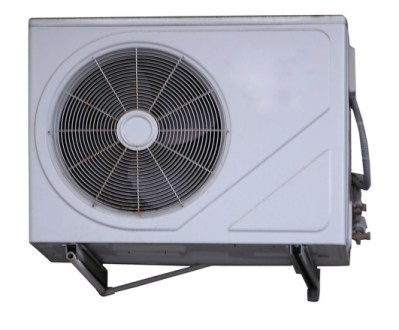
Air Conditioners are desperately needed throughout Alabama's prison system
Air Conditioners are desperately needed throughout Alabama’s prison system

Edwards and Medlock are trial lawyers with Edwards Law in Austin.

Texas, like other states, does not air condition its prisons—and by doing so, it kills people.

In 2011, the State of Texas convicted Larry McCollum of forgery, for passing a bad check. He was supposed to serve a short prison sentence of two years, then go home to his family. Instead, the conditions inside Texas prisons gave him a death sentence. He died of heat stroke—indoors.

Over 120,000 beds in the Texas Department of Criminal Justice system do not have air conditioning, including the Hutchins State Jail near Dallas, where Mr. McCollum was imprisoned. As a result, the indoor heat index—the combination of temperature and humidity—frequently exceeds 100 degrees on hot summer days. Shortly before Mr. McCollum died, the Hutchins’ warden received multiple emails from the risk manager, who took a thermometer around to the dorms, stating the temperature inside the inmate dormitories reached 102 degrees by early afternoon, and that the heat index inside was likely 123. While Mr. McCollum baked inside his dormitory, his body temperature rose to 109.4. Eventually, his body began to seize, and he was hospitalized. When his wife and adult children were summoned, they learned his body temperature had permanently damaged his brain, and he would not survive.

According to the National Weather Service, in an average year, heat kills more people than floods, lightning, tornadoes and hurricanes combined. In all, during the past 18 years, over 20 men have died with the cause of death of heat stroke inside prison buildings constructed and maintained by the State of Texas. Though the count is likely much higher: When temperatures go over 90 degrees, the medical risk of heat stroke increases markedly, and it can lead to other causes of death, especially for people with certain common medical conditions like diabetes, high blood pressure, or asthma, or who take certain medications, including most mental health prescriptions.

Continue reading

The warden refuses to listen to cries for help.

I was just released form the Montgomery Women’s Facility yesterday, 06/07/2016. The medical staff there has got to be the worst in the world. I spent 1 1/2 years in pain and sick only to find out last month I had “some kind” of mass in my side. I was given meds that I was allergic to, causing serious side effects. I have witnessed individuals become ill and need immediate attention and told to put in a sick call.

The heat inside the warehouse is over 100 degrees as we speak. Yet when organizations offer to donate a/c systems they are turned down even though women are falling out with heat exhaustion. Rules change not just on a daily basis but on the same shift from officer to officer. Why? Because the officers are allowed to run this camp, not a warden.

This facility is supposed to be for work release, yet over half are not. This facility currently houses 300 people in an 75 x 95 tin building. It is filthy, over run with rats, roaches and flies. The septic system must be emptied at least once a month and the fumes are toxic. There is a constant gas leak outside the building that causes nausea and head aches.

The water is from the prison next door and is constantly being shut off. State jobs are not assigned to age appropriate individuals. Often women over 50 will be put on outside/inside grounds working harder than some men. Not only are women punished for infractions with write ups they then must do extra duty. Does not matter if you are smoking in an unauthorized area or have a dirty urine the punishment is the same.

Continue reading

Why we should close women’s prisons and treat their crimes more fairly

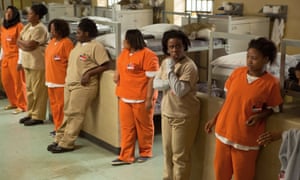
Photograph: K C Bailey/NetflixImage from Orange Is The New Black

‘Nearly every incarcerated woman is the victim of a perverse and lazy policy disfigurement that fails to acknowledge the marked differences between female and male offenders.’

By  and originally published by the guardian
 Professor Mirko Bagaric is the Director of the Centre for Evidence-Based Sentencing at Deakin University, Melbourne. Wednesday 1 June 2016 

Women almost never scare us; commit random acts of serious violence; violate our sexual integrity; or form organised crime networks and yet their prisons numbers are now the highest in recorded history.

The homogeneity of the human species breaks down when it comes to criminal behaviour. Women, who constitute slightly more than 50% of population, commit only about 20% of all crime. They commit even a lower portion of all serious crime.

Hillary Clinton is right to assert that the sentencing system should be reformed to reduce the growing number of female prisoners but the changes should go much further than has been suggested. We should implement concrete targets to remove the stains on our landscape and societal ethic that are women’s prisons.

There are remarkably similar patterns of female offending and incarceration in the United States and Australia. In the United States women commit only 17% of felonies, while in Australia they commit about 13% of the crimes dealt with in the higher courts.

Moreover, when it comes to sexual offences, rounded off to the nearest whole number, women constitute 0% of all offenders – that’s right, zero. The crimes they most commonly commit are drug and property offences. Thus, in the US, approximately 30% of female prisoners are incarcerated for property offences, and a further 26% for drug offences. The percentages for these offences are 26% and 17%, respectively, in Australia.

Women do of course commit homicide offences, but nearly always the victim is a relative and the crime was committed against the backdrop of an abusive relationship or depressive mindset. All homicides are heinous crimes but the types of homicides committed by women rarely involve random victims and hence do not engender community fear.

Despite this, the rate of female incarceration in both the United States and Australia is on the increase – far outstripping the increase in male incarceration levels. Women now comprise 8% of prisoners in the United States and Australia, which amounts to more than 200,000 incarcerated inmates in the US and 3,000 in Australia.

Nearly every one of these incarcerated women is the victim of a perverse and lazy policy disfigurement that fails to acknowledge the marked differences between female and male offenders. The differences are so stark that not only should women be treated more leniently because they commit less serious crime but they should also be treated more leniently when they commit the same crime as a man.

There are four major differences between male and female offenders.
Continue reading

Small Issues Tell a Bigger Story of Reverse Racism at Montgomery Women’s Facility

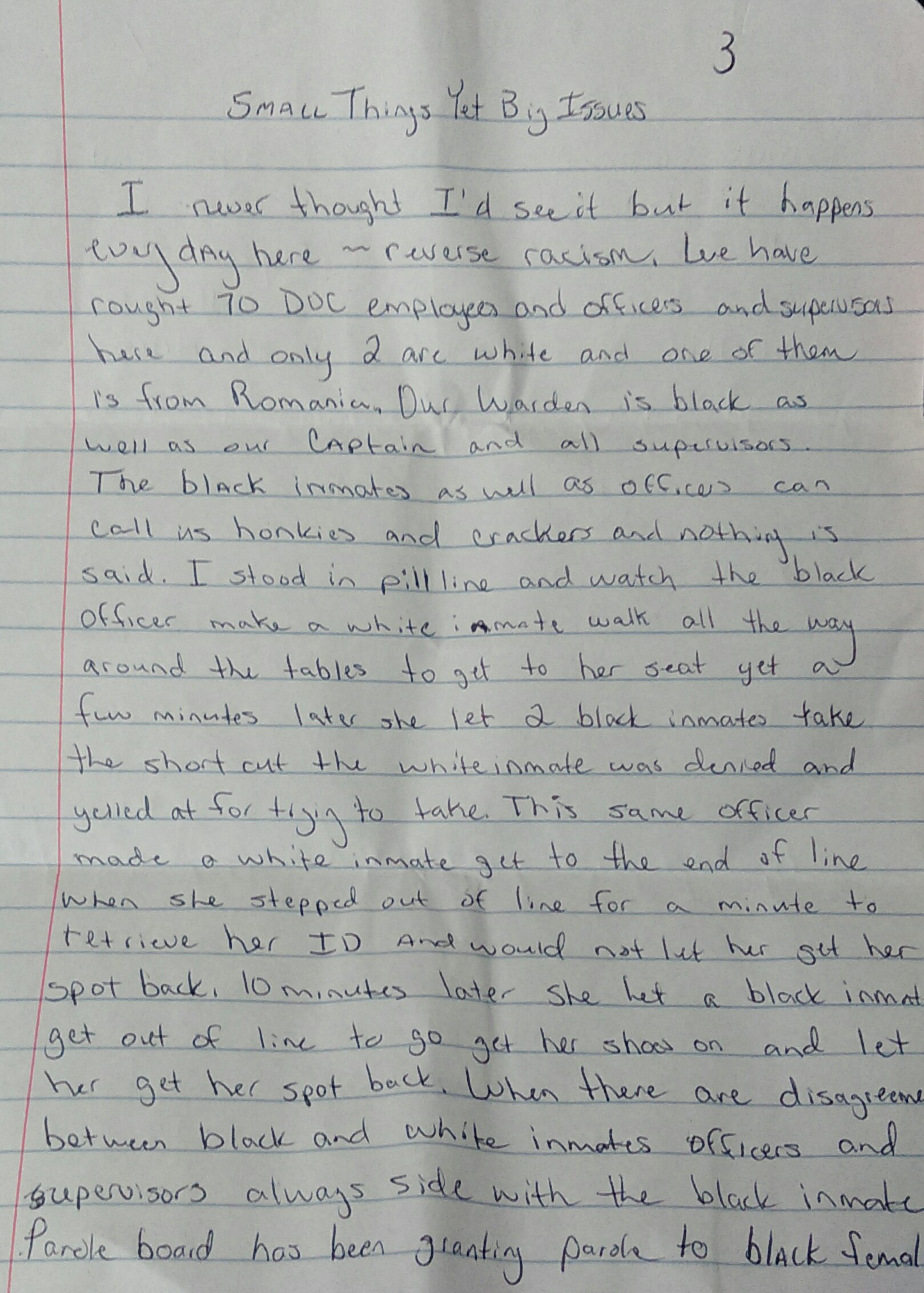
I never thought I’d see it, but it happens everyday here ~ reverse racism. We have roughly 70 Alabama Department Of Corrections employess and Officers and supervisors here and only 2 are white, and one is from Romania. Our Warden is black as well as our Captain and all supervisors.

image
Small issues tell a bigger story of reverse racism at Montgomery Women’s Facility

The black inmates as well as Officers can call us honkies and crackers and nothing is said. I stood in pill line and watched the black Officer make a white inmate walk all the way around the tables to get to her seat, yet a few minutes later, she let 2 black inmates take the short cut, the white inmate was denied and yelled at for trying to take.

This same Officer made a white inmate get to the end of line for a minute to retrieve her ID and would not let her get her spot back. When there are disagrements between black and white inmates, Officers and Supervisors always side with the black inmates.

Parole board has been granting parole to black females with violent crimes these past 3 years, but us white females with violent crimes have been denied parole and set off 5 years. No one is helping us and we are without hope at this corrupted facility ran by Alabama Department of Corrections.

Transcribed by admin from a statement by an inmate , identity withheld as she is in fear of retaliation.

D.O.C (Dummies Over the Convicted)

Mass confusion is an everyday occurrence inside the walls of Montgomery Women’s Facility. There are rules written out in the S.O.P’s (Standard Operating Procedures) that aren’t set forth and then there are rules given by the Warden, the Captain, the Lieutenants, the Sergeants, and Officers. On a daily basis a new rule is issued and usually unbeknownst to all inmates, therefore most are unaware.

Alabama D.O.C (Dummies Over the Convicted) an inmates statement alleging blatant disregard for rules and regulations at Montgomery Women's Facility.
Alabama D.O.C (Dummies Over the Convicted) an inmates statement alleging blatant disregard for rules and regulations at Montgomery Women’s Facility.

We never know which rule to go by because there aren’t any memo’s posted and most of the rules are contradictory to other rules. We also have to be aware of Staff members (Cynthia Steele) reading confidential mail from an inmate to the warden, to another inmate, which could have caused a major uproar between the two inmates. There’s no one here to trust with crucial problems that arise.

There are posters, posted everywhere stating that we should report our concerns about abuse and extortion, but when we do, the accused is forewarned by the P.R.E.A (Prison Rape Elimination Act) Officer Lt. Bentford. The accused lies and states that there was no such of an occurrence and then the investigation is thereby dropped. No witnesses for the defendants are ever called.

On one occasion during a P.M smoke break, Officer Williams walks through a crowd of inmates who are smoking “Spice“. She makes the sound of a siren, forewarning the “Smokers”. On another occasion, Officer Dickerson walks by a table outside where there are about 10 inmates who are smoking “Marijuana”. She passes them by to go to an inmate who is sitting in an open “wooden closet” to tell her she can’t sit there.

Continue reading

Violent, overcrowded Alabama prisons hit a breaking point​​​

http://player.pbs.org/viralplayer/2365713534

Alabama has the most overcrowded prison system in the nation: More than 24,000 inmates are housed in a system designed for half that number. The violence, overcrowding and actions taken by the federal government pushed state government to action, passing a penal reform bill. But does it go far enough? Jeffrey Brown reports.

JUDY WOODRUFF: Next: Alabama’s prison system at a breaking point.

The state currently packs more than 24,000 inmates into a system designed to house about half that number.

Jeffrey Brown looks inside the most overcrowded prison system in the nation. It’s part of our ongoing series Broken Justice about new approaches to criminal justice.

JEFFREY BROWN: The William C. Holman maximum security prison in Atmore, Alabama loud, crowded, and, when we visited just weeks after a riot broke out here, still in partial lockdown.

Continue reading