D.O.C (Dummies Over the Convicted)

Mass confusion is an everyday occurrence inside the walls of Montgomery Women’s Facility. There are rules written out in the S.O.P’s (Standard Operating Procedures) that aren’t set forth and then there are rules given by the Warden, the Captain, the Lieutenants, the Sergeants, and Officers. On a daily basis a new rule is issued and usually unbeknownst to all inmates, therefore most are unaware.

Alabama D.O.C (Dummies Over the Convicted) an inmates statement alleging blatant disregard for rules and regulations at Montgomery Women's Facility.
Alabama D.O.C (Dummies Over the Convicted) an inmates statement alleging blatant disregard for rules and regulations at Montgomery Women’s Facility.

We never know which rule to go by because there aren’t any memo’s posted and most of the rules are contradictory to other rules. We also have to be aware of Staff members (Cynthia Steele) reading confidential mail from an inmate to the warden, to another inmate, which could have caused a major uproar between the two inmates. There’s no one here to trust with crucial problems that arise.

There are posters, posted everywhere stating that we should report our concerns about abuse and extortion, but when we do, the accused is forewarned by the P.R.E.A (Prison Rape Elimination Act) Officer Lt. Bentford. The accused lies and states that there was no such of an occurrence and then the investigation is thereby dropped. No witnesses for the defendants are ever called.

On one occasion during a P.M smoke break, Officer Williams walks through a crowd of inmates who are smoking “Spice“. She makes the sound of a siren, forewarning the “Smokers”. On another occasion, Officer Dickerson walks by a table outside where there are about 10 inmates who are smoking “Marijuana”. She passes them by to go to an inmate who is sitting in an open “wooden closet” to tell her she can’t sit there.

Continue reading

Chow time, Supplies, Scamming Money and Warehouse Living. An inmates account of day to day living at Montgomery Women’s Facility

Chow Time

We have 300 inmates here and roughly 200-250 of us eat in the chow hall. They claim to give us 15 minutes to eat but they give us only 5 -7 minutes. We barely chew our food. We’ve learned just to eat as fast as we can and swallow without barely chewing the food. The food comes out of the server so hot it burns our mouths. All we get are starches. We get 1 apple a month and 1 orange a month. Breakfast, the most important meal, they give us 2 tablespoons of eggs, ¼ cup of grits or oatmeal and 1 biscuit that is the size of a golfball.

Chow time, supplies and warehouse living at Montgomery Women's Facility
Chow time, supplies and warehouse living at Montgomery Women’s Facility

We used to get desserts at lunch and dinner, but they cut the desserts down to 4 times a week. The stewardess alters the menu all the time. We are not fed according to the food pryimid. On 2nd shift the officers argue who is going to feed us. We’re supposed to eat at 04:30 but we don’t get fed till almost 5 and then we are yelled at the whole time whilst eating and are rushed to eat.

SUPPLIES – We’re supposed to get 1 bottle of shampoo, 4 bars of soap, deodorant, 1 razor, 1 tube of shower cream. The black folks get a shampoo and conditioner for their hair as well as hair grease, but the officer in charge of our supplies never orders enough. Today we ran out of the bottles of shampoo for white people and when the officer was asked, what was we who got no shampoo to do, her reply was “I guess you won’t have any shampoo”. We’re supposed to get supplies every 30 days, yet our supplies are every 45 days. This same officer was supposed to give us 3 pairs of state shorts along with 3 t-shirts, but she gave us only 1 pair of shorts and 1 t-shirt.

The other 2 female prisons got their 3 shorts and 3 t-shirts. We’re also supposed to get 2 pairs of shorts pyjamas and 2 pyjama pants, yet we get none of either. We get 6 panties 4 bras every 6 months. The panties tear up within a week and she never has our size. The panties are either too small or too big. The bras for big girls are rarely available, size 40 or bigger. We get sports bras, either too big or too small. I am out of panties altogether but cannot get any for another 4 months, so now i go without, which is against regs, yet its not my fault that i can’t get anymore.

Continue reading

Officers can scan and insert false and malicious documents into our files

Here at Montgomery Women’s Facility bullies are everywhere. Us who fall victim to the bullies and report it, are told we have to have witnesses to verify the bullying done to us. I was verbally attacked by another inmate right after our PREA (Prison Rape Elimination Act) video. This inmate called me names, made fun of my body and mocked me for some PREA incidents i had reported. She then came to the shower i was in to threaten me bodily harm. I left the shower in tears. The officer right outside the bathroom heard everything yet did nothing.

Experience with bullies at Montgomery Women's Facility
Experience with bullies at Montgomery Women’s Facility

I reported all this to our PREA rep and she called me a liar, said i had no proof, the officer who witnessed it said she heard nothing. I left in tears feeling hopeless. The next day, the inmate who got into it with her employer, the notorious canteen lady, threw my canteen at me for retaliation. I reported this as well and nothing was done. I was told to walk with a “bodyguard” at all times, so if the bullies picked on me again, i would have a witness. What bully picks on another in front of others?

This inmate violated everything that PREA says another inmate cannot do to another inmate, yet that inmate still resides at Montgomery Women’s Facility, bullying still. Overtime she passes me, she bumps into me, trying to instigate something. I say nothing because it does me no good to report to ones who are crooked and cover up stuff.

Continue reading

We are unable to contact PREA externally

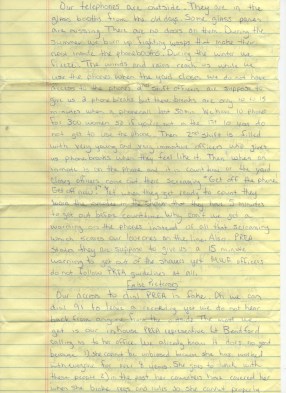
Our telephones are outside. They are in the glass booths from the old days. Some glass panes are missing. There are no doors on them. During the summer we burn up fighting wasps that make their nests inside the phone booths. During the winter we freeze. The winds and rains reach us while we use the phones. When the yard closes we do not have access to the phones and shift officers are supposed to give us 2 phone breaks, but these breaks are only 10-15 minutes, when a phone call lasts 30 minutes.

Inmates at Montgomery Women's Facility cannot contact PREA staff externally (Prison Rape Elimination Act)
Inmates at Montgomery Women’s Facility cannot contact PREA staff externally (Prison Rape Elimination Act)

We have 10 phones for 300 women, so if you’re not in the 1st 10, you do not get to use the phone. Then 2nd shift is filled with very young and very immature officers who give us phone breaks when they feel like it. Then when an inmate is on the phone and its count time or the yard closes, officers come out there screaming “Get off the phone!, Get off now!”. Yet when they get ready to count they warn the inmates in the shower, that they have 5 minutes to get out before count time.

Why can’t we get a warning on the phones instead of all that screaming, which scares our loved ones on the line? Also PREA (Prison Rape Elimination Act) states they are supposed to give us a 15 minute warning to get out of the showers, yet Montgomery Women’s Facility officers DO NOT follow PREA guidelines at all.

Continue reading

Animals are treated better than us

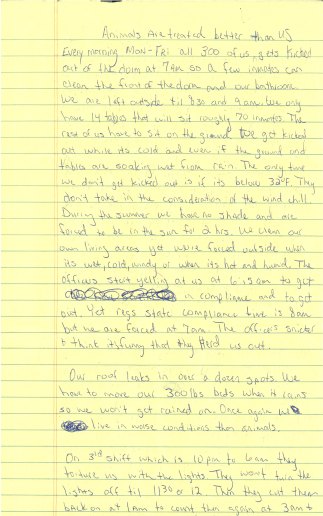
Every morning, Monday – Friday all 300 of us gets kicked out of the dorm at 7am so a few inmates can clean the front of the dorm and our bathroom. We are left outside till 08.30 and 9am. We only have 14 tables that will sit roughly 70 inmates. The rest of us have to sit on the ground. We get kicked out while its cold and even if the ground and tables are soaking wet from rain. The only time we don’t get kicked out is if its below 32°f.

Statement form an inmate highlighting the daily routine in Montgomery Women's Facility
Statement form an inmate highlighting the daily routine in Montgomery Women’s Facility

They don’t take into consideration of the wind chill. During the summer we have no shade and are forced to be in the sun for 2 hrs. We clean our own living areas yet we’re forced outside when its wet, cold, windy or when its hot and humid. The officers start yelling at us at 06:15 to get in compliance and to get out. Yet regs state compliance time is 08:00 but we are forced at 07:00. The officers snicker and think its funny that they herd us out.

Our roof leaks in over a dozen spots. We have to move our 300lbs beds when it rains, so we won’t get rained on. Once again, we live in worse conditions than animals.

On 3rd shift, which is 22:00 to 06:00 they torture us with the lights. They won’t turn the lights off till 23:30 or 00:00, then they cut them back on at 01:00 to count, then again at 03:00 and they remain on all morning. We are sleep deprived.

On our pill line, there are over 70 of us, yet the officers will call everyone up there at one time creating a cluster of people blocking aisles. Some of us will go as the pill line goes down to about 15 inmates, yet the officers will prevent us from getting our meds, saying we are late to pill line. Yet how can i be late to pill line, when pill line is still going? The night before last, a Sgt. actually wrote up an inmate for taking her medicine after she came to pill line, when the line still had 10 inmates in line. We are not to be refused our meds, yet we are at Montgomery Women’s Facility.

Continue reading

Why you should care about ensuring defendants get a fair trial

By Kira Fonteneau, Jefferson County Public Defender

On March 18, 1963, in “Gideon v. Wainwright,” the United States Supreme Court recognized that people who are charged with crimes are entitled to legal counsel even if they cannot afford to pay for it themselves. By upholding the constitutional right to an attorney, the Court empowered the justice system as a whole.

Kira Fonteneau, Jefferson County Public Defender c/o Kira Fonteneau

“Our state and national constitutions and laws have laid great emphasis on procedural and substantive safeguards designed to assure fair trials before impartial tribunals in which every defendant stands equal before the law,” declared Justice Hugo Black, an Alabama native, in the court’s opinion. “This noble ideal cannot be realized if the poor man charged with crime has to face his accusers without a lawyer to assist him.”

Since Gideon, a generation of lawyers and other professionals have worked tirelessly to defend clients who would otherwise be crushed under the weight of the criminal justice system.

As lawyers who represent the poor in Alabama, we know that many people have mixed feelings about the role criminal defense lawyers play in society.  It can be hard for the public to separate an individual from the grievous crimes he is accused of by the government. All too often, that societal distrust of alleged criminals is extended toward the people who defend them. As a result, there is a natural tendency to downplay the importance of providing a quality defense to those who are accused.

Justice is only possible when it is extended to all parties in the criminal system.

Continue reading

Statement alleging racism and special treatment, rife at Montgomery Women’s Facility

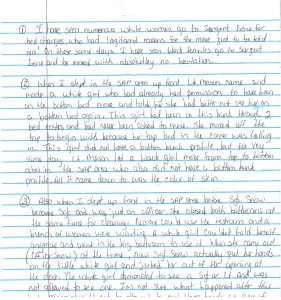
  • I have seen numerous white women go to Sgt. Jene for bed changes, who had legitimate reasons for the move just to be told No! On these same days i have seen black females go to Sgt. Jene and be moved with absolutely no hesitation.
Statement alleging racism and special treatment, rife at Montgomery Women's Facility
Statement alleging racism and special treatment, rife at Montgomery Women’s Facility
  • When i slept in the SAP area up front Lt. Mason came and made a white girl who had already had permission to have been on the bottom bed move, and told her she had better not see her on a bottom bed again. This girl had been on this bunk through 2 bed rosters and had never been asked to move. She moved off the top to begin with because her top bed win the corner was falling in. This girl did not have a bottom bunk profile, but the very same day Lt. Mason let a black girl move from top to bottom, also in the SAP area who also did not have a bottom bunk profile. All it came down to was the color of skin.
  • Also, when i slept up front in the SAP area before Sgt. Snow became Sgt. and was just an officer, she closed both bathrooms at the same time for cleaning. No one could use the restroom and a bunch of women were waiting. A white girl couldn’t hold herself anymore and went in the big bathroom to use it. When she came out (officer Snow) at the time, Now Sgt Snow actually put her hands on the little white girl and jerked her out of the opening of the door. The white girl demanded to see a Sgt. or Lt. and was not allowed to see one. I’m not sure what happened after this, but officers should not be allowed to put their hands on any of us inmates, we’re people too who are being punished already by being here and the guards try to find any reason to punish us or degrade us more than we already are.

Continue reading

Prison secrets: AL.com investigation finds prison bosses have little to fear from breaking the rules

Warden Carter Davenport (right) speaks to media members during a tour as State Senator Cam Ward (center) and Kim Thomas, Commissioner of the Alabama Department of Corrections listen at the St. Clair Correctional Facility Fri., March 16, 2012 in Springville, Ala. (The Birmingham News/Bernard Troncale). (BERNARD TRONCALE)
By Casey Toner – on June 13, 2014 at 5:33 AM, updated March 12, 2016 at 1:48 PM

SPRINGVILLE, Alabama — On a routine cell transfer in 2012, a handcuffed inmate at St. Clair Correctional Facility had a few choice words that pricked the ear of Warden Carter Davenport.

Davenport, then a 24-year corrections veteran, wasn’t going to let it slide. Not in the state’s second-most-violent prison. Not from an inmate placed in segregation — a dorm reserved for the prison’s worst troublemakers.

Incensed, Davenport clenched his fist and cracked him in the head. When the inmate quieted down, Davenport removed his shackles and led him back to his cell.

In most places, it is a crime to punch a handcuffed man. But in Alabama’s correctional system, it is a merely a policy violation, which was documented in Davenport’s personnel file. There was no investigation of the case, no interview with the inmate, and no record made of his injuries. Davenport received a two-day suspension, which he served the following month.

An AL.com analysis of hundreds of personnel documents shows that the state’s wardens can flout the rules, take a slap on the wrist, return to work or transfer to other prisons. In fact, some wardens were promoted to their positions even after serving suspensions as lower-ranking officers for beating inmates or covering up beatings.

Continue reading

Alabama prisons to improve treatment of inmates with disabilities

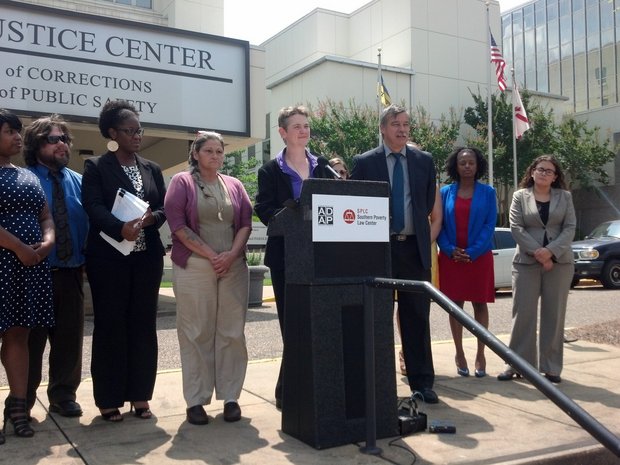
Maria Morris, managing attorney for the Southern Poverty Law Center, announces a federal lawsuit against the Alabama Department of Corrections alleging that the system violates federal law by ignoring inmates' medical and mental health needs. Morris spoke outside DOC's offices in Montgomery, Ala., on June 17, 2014. Morris was joined by William Van Der Pol Jr., staff attorney for the Alabama Disabilities Advocacy Program, which is also taking part in the lawsuit, alleging discrimination against prisoners with disabilities. (Mike Cason/mcason@al.com)
Maria Morris, managing attorney for the Southern Poverty Law Center, announces a federal lawsuit against the Alabama Department of Corrections alleging that the system violates federal law by ignoring inmates’ medical and mental health needs. Morris spoke outside DOC’s offices in Montgomery, Ala., on June 17, 2014. Morris was joined by William Van Der Pol Jr., staff attorney for the Alabama Disabilities Advocacy Program, which is also taking part in the lawsuit, alleging discrimination against prisoners with disabilities. (Mike Cason/mcason@al.com)
By Kelsey Stein – on March 16, 2016 at 9:52 AM, updated March 16, 2016 at 10:31 AM

Alabama inmates with disabilities will soon receive the necessary treatment and services, under a recent agreement between the Southern Poverty Law Center and the Alabama Department of Corrections.

SPLC filed a lawsuit in June 2014 claiming that state officials knew about problems within the system but had not acted to bring conditions to a “humane and constitutional” level. The plaintiffs include 40 named inmates who offer details about their individual encounters with inadequate health care.

The agreement outlines steps ADOC will take to ensure compliance with the Americans with Disabilities Act. A monitor will oversee the implementation of the agreement’s provisions.

“This agreement is an important commitment by the Alabama Department of Corrections to address the discrimination and hardship these prisoners have faced for far too long,” said Maria Morris, SPLC senior supervising attorney. “Prisoners with disabilities must have an opportunity to serve the sentence they have received – not the sentence they must endure because the state fails to respect their legal rights.”

Continue reading